Elephanta Caves
<---©-আদ্যনাথ--->
আমি কিছুদিন ছিলাম বোম্বে হইতে ONGCর জাহাজে তখন কিন্তু জানতাম না এই এলিফেনটা গুহার ব্যাপারে। পরে একদিন দেখলাম ও জানলাম এই এলিফেন্টার ব্যাপারে খবরের কাগজ পড়ে।
আর তখনি মন ব্যাকুল হলো এলিফেন্টা দেখার জন্য।1990 র ডিসেম্বরে সুযোগ ও ছুটি পেলাম ,
আমরা চারজন প্ল্যান করলাম। কিন্তু বিশেষ কোন কারনে ভি সি আর পিল্লাইকে বাড়ি যেতে হল তাই আমরা তিন জন সন্তোষ দত্ত ,হীরামোহন পান্ডে ,ও আমি যাবার জন্য তৈরী হলাম। তখনো ট্রেনের টিকিট কাটা হয়নি। একদিন গেলাম ধানবাদে ট্রেনের টিকিট কাটতে ,স্টেশনে অমিতের সাথে দেখা। অমিত তখন ডিউটিতে ,ধানবাদ স্টেশনের টিকিট কলেক্টর।
অমিত ঘড়াই আমাদের টুরের প্ল্যান শুনে নিজেই রাজিহয়ে গেল আমাদের সাথে যাবার জন্য।
অমিত নিজেই টিকিট কাটার দায়িত্ব নিয়েছিল।
আমরা চারজন যথারিতি বৃহষ্পতিবার 22 নভেম্বর 1990 বোম্বে মেল্ 02:30am এতে রওনা দিলাম।
ট্রেনে দুই রাট কাটিয়ে শনিবার বার দুপুর 12;30 মিটিত নাগাদ আমরা বোম্বে পৌঁছলাম। সেদিন এক হোটেলে থাকলাম বিকেলের দিকে জুহু বিচে ঘুড়ে বেরিয়ে হোটেলে রাত কাটিয়ে সকালে চলে গেলাম গেলাম 'গেটওয়ে অফ ইন্ডিয়া '.সেখান থেকে ফেরিতে এলিফেন্টার জেটিঘাট থেকে টয়ট্রেনে গুহা পর্যন্ত।
আমরা রবিবার 25 নভেম্বর সকাল 10 টা থেকে 5 টা পর্যন্ত ঘুরে দেখলাম গুহা গুলি।
আমরা সত্যি ভাগ্যবান যে এই দিন বিশেষ পোগ্রাম দেখতে পেলাম বিশ্ব হেরিটেজ সপ্তাহ পালনের অনুষ্ঠান। নাচে গানে ও নানান অনুষ্ঠানে সেদিন ছিল অপূর্ব এক দর্শনীয় দিন।
কিন্তু অপূর্ব এই গুহাগুলির বর্ণনা করা আমার পক্ষে সম্ভব নয় ,সেই কারনে সকল কিছু মনে রাখতে ইন্টারনেটের সাহায্য নিলাম।
প্রত্যেক দিন সকাল 9 টা থেকে বিকেল 5 টা পর্যন্ত গুহা দেখার সময়।
আর প্রত্যেক সোমবার গুহা প্রদর্শন সম্পূর্ণ বন্ধ থাকে।
Collection from internet
UNESCO World Heritage SiteElephanta Caves
घारापुरीची लेणी
Name as inscribed on the World Heritage List

20 feet (6.1 m) high Trimurti sculpture
Type Cultural
Criteria
Reference 244 rev
UNESCO region South Asia
Inscription history
Inscription 1987 (11th Session)
History of Elephanta caves
Since no inscriptions on any of the island have been discovered, the ancient history of the island is conjectural, at best. Pandavas, the heroes of the Hindu epic Mahabharata, and Banasura, the demon devotee of Shiva, are both credited with building temples or cut caves to live. Local tradition holds that the caves are not man-made.
"Elephanta caves are a network of sculpted( ভাস্কর্য ) caves located on Elephanta Island, or Gharapuri (literally "the city of caves") in Mumbai Harbour ( পোতাশ্রয়, বন্দর ), 10 kilometres (6.2 mi) to the east of the city of Mumbai in the Indian state of Maharashtra. The island, located on an arm of the Arabian Sea, consists of two groups of caves—the first is a large group of five Hindu caves, the second, a smaller group of twoBuddhist caves. The Hindu caves contain rock cut stone sculptures, representing the Shaiva Hindu sect, dedicated to the LordShiva.
The rock cut architecture of the caves has been dated to between the 5th and 8th centuries, although the identity of the original builders is still a subject of debate. The caves are hewn from solid basalt rock. All the caves were also originally painted in the past, but now only traces remain.
The main cave (Cave 1, or the Great Cave) was a Hindu place of worship until Portuguese rule began in 1534, after which the caves suffered severe damage. This cave was renovated in the 1970s after years of neglect, and was designated a UNESCO World Heritage Site in 1987 to preserve the artwork. It is currently maintained by the Archaeological Survey of India (ASI).
Geography[edit]


Elephanta
Elephanta (Mumbai)

The hills of the Elephanta Islands
Elephanta Island, or Gharapuri, is about 11 km (6.8 mi) east of the Apollo Bunder (Bunder in Marathi means a "pier for embarkation and disembarkation of passengers and goods") on the MumbaiHarbour and 10 km (6.2 mi) south of Pir Pal in Trombay. The island covers about 10 km2 (3.9 sq mi) at high tide and about 16 km2 (6.2 sq mi) at low tide. Gharapuri is small village on the south side of the island. The Elephanta Caves can be reached by a ferry from the Gateway of India, Mumbai, which has the nearest airport and train station.
The cave is closed on Monday.
The island is 2.4 km (1.5 mi) in length with two hills that rise to a height of about 150 m (490 ft). A deep ravine cuts through the heart of the island from north to south. On the west, the hill rises gently from the sea and stretches east across the ravine and rises gradually to the extreme east to a height of 173 m (568 ft). This hill is known as the Stupa hill. Forest growth with clusters of mango, tamarind, and karanj trees cover the hills with scattered palm trees. Rice fields are seen in the valley. The fore shore is made up of sand and mud with mangrove bushes on the fringe. Landing quays sit near three small hamlets known as Set Bunder in the north-west, Mora Bunder in the northeast, and Gharapuri or Raj Bunder in the south.
The two hills of the island, the western and the eastern, have five rock-cut caves in the western part and a brick stupa on the eastern hill on its top composed of two caves with a few rock-cut cisterns. One of the caves on the eastern hill is unfinished. It is a protected island with a buffer zone according to a Notification issued in 1985, which also includes "a prohibited area" that stretches 1 kilometre (0.62 mi) from the shoreline.
The Elephanta caves are "of unknown date and attribution". Art historians have dated the caves in the range of late 5th to late 8th century AD.Archaeological excavations have unearthed a few Kshatrapa coins dated to 4th century AD. The known history is traced only to the defeat of Mauryan rulers of Konkan by the Badami Chalukyas emperor Pulakesi II (609–642) in a naval battle, in 635 AD. Elephanta was then called Puri or Purika, and served as the capital of the Konkan Mauryas. Some historians attribute the caves to the Konkan Mauryas, dating them to the mid-6th century, though others refute this claim saying a relatively small kingdom like the Konkan Mauryas could not undertake "an almost superhuman excavation effort," which was needed to carve the rock temples from solid rock and could not have the skilled labor to produce such "high quality" sculpture.

Caves of Elephanta, c. 1905. Note the broken pillars, which were restored in the 1970s.
Some other historians attribute the construction to the Kalachuris (late 5th to 6th century), who may have had a feudal relationship with the Konkan Mauryas. In an era where polytheism was prevalent, the Elephanta main cave dedicates the monotheism of the Pashupata Shaivism sect, a sect to which Kalachuris as well as Konkan Mauryas belonged.
The Chalukyas, who defeated the Kalachuris as well as the Konkan Mauryas, are also believed by some to be creators of the main cave, in the mid-7th century. The Rashtrakutas are the last claimants to the creation of the main cave, approximated to the early 7th to late 8th century. The Elephanta Shiva cave resembles in some aspects the 8th-century Rashtrakuta rock-temple Kailash at Ellora. The Trimurti of Elephanta showing the three faces of Shiva is akin to the Trimurti of Brahma, Vishnu and Mahesh (Shiva), which was the royal insignia of the Rashtrakutas. The Nataraja and Ardhanarishvara sculptures are also attributed to the Rashtrakutas.

The elephant sculpture from Elephanta is currently installed at theJijamata Udyaan.
এটি ইন্টারনেটে পেলাম ,আমরা কিন্তু এটি দেখিনি। তাই মনে হয় 1990 এর পরে এটি বানিয়েছে।
Later, Elephanta was ruled by another Chalukyan dynasty, and then by Gujarat Sultanate, who surrendered it to the Portuguese in 1534. By then, Elephanta was called Gharapuri, which denotes a hill settlement. The name is still used in the local Marathi language. The Portuguese named the island "Elephanta Island" in honour of a huge rock-cut black stone statue of an elephant that was then installed on a mound, a short distance east of Gharapuri village. The elephant now sits in the Jijamata Udyaan zoo in Mumbai.
Portuguese rule saw a decline in the Hindu population on the island and the abandonment of the Shiva cave (main cave) as a regular Hindu place of worship, though worship on Mahashivratri, the festival of Shiva, continued and still does. The Portuguese did considerable damage to the sanctuaries. Portuguese soldiers used the reliefs of Shiva in the main cave for target practice, sparing only the Trimurti sculpture. They also removed an inscription related to the creation of the caves. While some historians solely blame the Portuguese for the destruction of the caves, others also cite water-logging and dripping rainwater as additional damaging factors. The Portuguese left in 1661 as per the marriage treaty of Charles II of England and Catherine of Braganza, daughter of King John IV of Portugal. This marriage shifted possession of the islands to the British Empire, as part of Catherine's dowry to Charles.
Though the main cave was restored in the 1970s, other caves, including three consisting of important sculptures, are still badly damaged. The caves were designated a UNESCO World Heritage Site in 1987 as per the cultural criteria of UNESCO: the caves "represent a masterpiece of human creative genius" and "bear a unique or at least exceptional testimony to a cultural tradition or to a civilisation which is living or which has disappeared".
গুহার বর্ণনা ------
The island has two groups of caves in the rock-cut architectural style. The caves are hewn from solid basalt rock. All caves were painted in the past, but only traces remain. The larger group of caves, which consists of five caves on the western hill of the island, is well known for its Hindu sculptures. The primary cave, numbered as Cave 1, is about 1.5 km (0.93 mi) up a hillside, facing the ocean. It is a rock-cut temple complex that covers an area of 5,600 m2 (60,000 sq ft), and consists of a main chamber, two lateral chambers, courtyards, and subsidiary shrines. It is 39 metres (128 ft) deep from the front entrance to the back. The temple complex is the abode of Shiva, depicted in widely celebrated carvings which reveal his several forms and acts.
On the eastern part of the island, on the Stupa Hill, there is a small group of caves that house Buddhist monuments. This hill is named after the religious Stupa monument that they display. One of the two caves is incomplete, while the other contains a Stupa made in brick.
Main cave[edit]

Shiva cave (main cave).

Pillars and chamber in Shiva cave (main cave).

Cave 1 east entrance (right door) middle courtyard connecting the east-end cave (left door).
The main cave, also called the Shiva cave, Cave 1, or the Great Cave, is 27 metres (89 ft) square in plan with a hall (mandapa). At the entrance are four doors, with three open porticoes and an aisle at the back. Pillars, six in each row, divide the hall into a series of smaller chambers. The roof of the hall has concealed beams supported by stone columns joined together by capitals. The cave entrance is aligned with the north–south axis, unusual for a Shiva shrine (normally east–west). The northern entrance to the cave, which has 1,000 steep steps, is flanked by two panels of Shiva dated to the Gupta period. The left panel depicts Yogishvara (The Lord of Yoga) and the right shows Nataraja (Shiva as the Lord of Dance). The central Shiva shrine (see 16 in plan below) is a free-standing square cell with four entrances, located in the right section of the main hall. Smaller shrines are located at the east and west ends of the caves. The eastern sanctuary serves as a ceremonial entrance.
Each wall has large carvings of Shiva, each more than 5 metres (16 ft) in height. The central Shiva relief Trimurti is located on the south wall and is flanked by Ardhanarisvara (a half-man, half-woman representation of Shiva) on its left and Gangadhara to its right, which denotes the River Ganges' descent from Shiva's matted locks. Other carvings related to the legend of Shiva are also seen in the main hall at strategic locations in exclusive cubicles; these include Kalyanasundaramurti, depicting Shiva's marriage to the goddess Parvati, Andhakasuravadamurti or Andhakasuramardana, the slaying of the demon Andhaka by Shiva, Shiva-Parvati onMount Kailash (the abode of Shiva), and Ravananugraha, depicting the demon-king Ravana shaking Kailash.
The main cave blends Chalukyan architectural features such as massive figures of the divinities, guardians, and square pillars with custom capitals with Gupta artistic characteristics, like the depiction of mountains and clouds and female hairstyles.

Layout:
Main Hall 1. Ravana lifting Kailash
2. Shiva-Parvati on Kailash
3. Ardhanarishvara
4. Trimurti
5. Gangadhara
6. Wedding of Shiva
7. Shiva slaying Andhaka
8. Nataraja
9. Yogishvara
16. Linga
East Wing Shrine
10. Kartikeya
11. Matrikas
12. Ganesha
13. Dvarapala
West Wing Shrine
14. Yogishvara
15. Nataraja
Shiva-Parvati on Kailash and Ravana lifting Kailash


Left: Shiva and Parvati on Mount Kailasha. Right: Ravana shaking Mount Kailash.
The carving on the south wall to the east of the portico depicts Shiva and Parvati seated on their abode Mount Kailash. The four-armed Shiva is seen with a crown and a disc behind it (all damaged), the sacred thread across his chest, and a dressing gown covering up to the knee. Parvati, dressed in her finery with her hair falling to the front, looks away. Behind her at the right is a woman attendant holding the child, identified with her son Kartikeya, the war-god. Many male and female attendants are seen behind the main figures. Shiva's attendant, the skeleton-like Bhringi, is seated at his feet. Other figures, not distinct, depict, among others, a royal-looking tall person, ascetics, a fat figure, a dwarf, a bull (the mount of Shiva), features of a Garuda, and two monkeys. The scenic beauty of the mountain is sculpted with the sky background amidst heavenly beings showering flowers on Shiva-Parvati. This scene is interpreted as a gambling scene, where Parvati is angry as Shiva cheats in a game of dice.
The carved panel facing this one is a two-level depiction of Ravana lifting Kailash. The upper scene is Mount Kailash, where Shiva and Parvati are seated. The eight-armed, three-eyed Shiva wears headgear with a crescent and disc behind it. Most of his arms are broken, two of them resting on attendants' heads. The Parvati figure, seated facing Shiva, remains only as a trunk. The panel is flanked by door keepers. Attendants of Shiva are also seen in the relief but mostly in a damaged state. Bhringi is seated near Shiva's feet and to his left is the elephant-headed son of Shiva, Ganesha. In this ensemble, the ten-headed demon-king Ravana is seen, with only one head left unscathed, and out of his twenty arms, only a few are discernible. Around Ravana are several demons. Numerous figures are seen above Shiva: the god Vishnu, riding his mount Garuda, to his left; a skeleton-figure; and in a recess, Parvati's mount, a tiger is depicted.
A legend relates to both these panels. Once, Parvati was annoyed with Shiva. At this moment, Ravana, who was passing by Mount Kailash, found it as an obstruction to his movement. Upset, Ravana shook it vigorously and as a result, Parvati got scared and hugged Shiva. Enraged by Ravana's arrogance, Shiva stamped down on Ravana, who sang praises of Shiva to free him of his misery and turned into an ardent devotee of Shiva. Another version states that Shiva was pleased with Ravana for restoring Parvati's composure and blessed him.
Trimurti, Gangadhara and Ardhanarishvara

Gangadhara Shiva (right) with part of the Trimurti and a guardian (left).
Described as a "masterpiece of Gupta-Chalukyan art", the most important sculpture in the caves is the Trimurti, carved in relief at the back of the cave facing the entrance, on the north-south axis. It is also known as Trimurti Sadashiva and Maheshmurti. The image, 6 m (20 ft) in height, depicts a three-headed Shiva, representing Panchamukha Shiva. The three heads are said to represent three essential aspects of Shiva: creation, protection, and destruction. The right half-face (west face) shows him as a young person with sensuous lips, embodying life and its vitality. In his hand he holds an object resembling a rosebud, depicting the promise of life and creativity. This face is closest to that of Brahma, the creator or Uma or Vamadeva, the feminine side of Shiva and creator of joy and beauty. The left half-face (east face) is that of a moustached young man, displaying anger. This is Shiva as the terrifying Aghora or Bhairava, the one whose anger can engulf the entire world in flames, leaving only ashes behind. This is also known as Rudra-Shiva, the Destroyer. The central face, benign and meditative, resembles the preserver Vishnu. This is Tatpurusha, "master of positive and negative principles of existence and preserver of their harmony" or Shiva as the yogi Yogeshwar in deep meditation praying for the preservation of humanity. The aspects Sadyojata and Ishana (not carved) faces are considered to be at the back and top of the sculpture. The Trimurti sculpture, with the Gateway of India in the background, has been adopted as the logo of the Maharashtra Tourism Department (MTDC).

Ardhanarishvara (centre) at Elephanta caves. Note the sculpture's left is female and the right is male, depicting Shiva and his consort Parvati.
The Gangadhara image to the right of the Trimurti is an ensemble of divinities assembled around the central figures of Shiva and Parvati, the former bearing the River Ganges as she descends from heaven. The carving is 4 m (13 ft) wide and 5.207 m (17.08 ft) high. The image is highly damaged, particularly the lower half of Shiva seen seated with Parvati, who is shown with four arms, two of which are broken. From the crown, a cup with a triple-headed female figure (with broken arms), representing the three sacred rivers Ganges, Yamuna, and Sarasvati, is depicted. Shiva is sculpted and bedecked with ornaments. The arms hold a coiling serpent whose hood is seen above his left shoulder. Another hand (partly broken) gives the semblance of Shiva hugging Parvati, with a head of matted hair. There is a small snake on the right hand and a tortoise close to the neck, with a bundle tied to the back. An ornamented drapery covers his lower torso, below the waist. Parvati is carved to the left of Shiva with a coiffured hair dress, fully bedecked with ornaments and jewellery, also fully draped, with her right hand touching the head of a female attendant who carries Parvati's dress case. The gods Brahma and Indra, with their mystic regalia and mounts, are shown to the right of Shiva; Vishnu, riding his mount Garuda, is shown to the left of Parvati. Many other details are defaced but a kneeling figure in the front is inferred to be the king who ordered the image to be carved. There are many divinities and attendant females at the back. The whole setting is under the sky and cloud scenes, with men and women, all dressed, shown showering flowers on the deities.
In the chamber to the east of the Trimurti is the four-armed Ardhanarishvara carving. This image, which is 5.11 m (16.8 ft) in height, has a headdress (double-folded) with two pleats draped towards the female head (Parvati) and the right side (Shiva) depicting curled hair and a crescent. The female figure has all the ornamentation (broad armlets and long bracelets, a large ring in the ear, jewelled rings on the fingers) but the right male figure has drooping hair, armlets and wristlets. One of his hands rests on Nandi’s left horn, Shiva's mount, which is fairly well preserved. The pair of hands at the back is also bejewelled; the right hand of the male holds a serpent, while the left hand of the female holds a mirror. The front left hand is broken but conjectured as holding the robe of the goddess. The central figure is surrounded by divinities.
Shiva slaying Andhaka and Wedding of Shiva

Shiva slaying Andhaka
The engraved panel in the north end of the aisle is considered to be a unique sculpture, and shows Bhairava, or Virabhadra, a frightful form of Shiva. In the carved panel Shiva's consort is seen sitting next to him, looking terrified. A female attendant is next to her. The central figure, which is much ruined below the waist, is 3.5 m (11 ft) high and posed as if running. His headgear has a ruff on the back, a skull and cobra over the forehead, and the crescent high on the right. His facial expression is of intense anger discerned from his furrowed brow, swollen eyes, and tusks. The legs and five of the eight arms are broken, attributed to Portuguese vandalism. The smaller broken image Andhaka is seen below Bhairava's image. It is interpreted that Shiva is spearing him with the front right hand, as conjectured by the spear seen hanging without any hold. Also seen is the back hand lifted up and holding an elephant's skin as a cover; the elephant's head, carved tusk, and trunk are seen hanging from the left hand. The second left hand depicts a snake coiled round it. The hand holds a bowl to collect the blood dripping from the slain Andhaka. Furthermore, pieces of a male and two female forms, figures of two ascetics, a small figure in front, a female figure, and two dwarfs are also seen in the carved panel. An unusual sculpture seen above the head of the main figure of Shiva is of a "very wide bottle with a curved groove in the middle of it", which can interpreted variously as: the aum or the linga or a Shiva shrine.

Panel depictingKalyanasundara: the divine marriage of Shiva and Parvati with Brahma, Vishnu, Indra, and other divinities in attendance.
The niche image carved on the south wall is an ensemble of divinities assembled around the central figures of Shiva and Parvati shown getting married (Kalyanasundara icon). Parvati is seen standing to Shiva's right, the ordained place for a Hindu bride at the wedding. The carvings are substantially damaged; only one of Shiva's four hands is fully seen and the right leg is missing. Shiva has a headdress with a shining disc attached to it. His garments are well-draped, and well-tied at the waist. The sacred thread is seen across his chest. Parvati is carved as a perfect figure with coiffured hair dress, well adorned with jewellery and is draped tightly to display depressions below the waist only. She is seen with a coy expression and is led by her father who has his right hand on her shoulder. Even though both her hands are damaged, it is inferred that her left hand clasped Shiva's right hand as a mark of holy alliance. Brahma is sitting as the officiating priest for the marriage. Vishnu is witness to the marriage. Mena, the mother of Parvati, is seen standing next to Vishnu. The moon-godChandra, seen with a wig and a crescent, is standing behind Parvati holding a circular pot with nectar for the marriage ceremony. Just above the main images, a galaxy of divinities, bearded sages, apsaras (nymphs), Vidyadharas, Yakshis, Gandharvas, Bhringi, and other male and female attendants are seen as witness to the marriage ceremony showering flowers on the divine couple.
Yogishvara and Nataraja[edit]

Shiva as Yogisvara, doing penance.
The panel to the east of the north portico is Shiva in a Yogic position called Yogisvara, Mahayogi, Dharmaraja andLakulish.Resembling a Buddha, Shiva is in a dilapidated condition with only two broken arms. Shiva is seated inpadmasana yogic posture (cross legged) on a lotus carried by two Nāgas. His crown is carved with details adorned by a crescent, a round frill at the back, and hair curls dropping on either side of the shoulders. His face is calm in mediation, his eyes half-closed. This represents Shiva in penance sitting amidst the Himalayan mountains after the death of his first wifeSati, who was later reborn as Parvati. He is surrounded by divinities in the sky and attendants below. Also seen is a plantain with three leaves already open and one opening, as well as a sunflower blossom. These are flanked by two attendants. Other figures discerned from a study of the broken images are: Vishnu riding Garuda on a plantain leaf; the Sun-god Surya riding a fully saddled horse (head missing); a saint with a rosary; two female figures in the sky draped up to their thighs; a faceless figure of the moon with a water container; three identical figures of a male flanked by two females; the skeleton of a sage; Brahma (without one arm) riding a swan; and Indra without his mount (elephant missing).

Shiva as Nataraja (Cosmic dancer)
The panel carving in the west niche opposite Yogishvara depicts Shiva as Nataraja performing theTandava (cosmic dance). The niche is 4 m (13 ft) wide and 3.4 m (11 ft) high and set low on the wall. He wears well-decorated headgear. The Shiva image displays a dance pose and had ten arms, but the first right and third left hands are missing. The remaining first right arm is held across the breast and touches the left side, the second right hand that is seen damaged with an out-flaying pose is broken at the elbow. The third arm is damaged at the elbow, and the fourth is also broken but inferred to have held a Khatvanga (skull-club). The left arms, seen hanging, are damaged near the wrists. The third hand is bent (but broken) towards Parvati standing on the side and the fourth hand is raised up. The right thigh (broken) is lifted up, and the left leg is not seen at all, the elaborate armlets are well-preserved and a skirt round the waist is tied by a ribbon. A tall figurine of Parvati stands to the left of Shiva, which is also seen partly broken but well bejewelled. An airborne female figure is seen behind Parvati. Other figures seen in the relief are: Vishnu riding a Garuda; Indra riding his elephant; the elephant-headed Ganesha; Kartikeya; Bhrngi; sages and attendants.
Main cave shrine[edit]

Shiva Linga shrine and Dvarapalas at door entry.
The central shrine is a free-standing square cell, with entrances on each of its sides. Each door is flanked by two dvarapalas (gate keepers). The Linga, the symbol of Shiva in union with the Yoni, and the symbol of Parvati together symbolise the supreme unity that is deified by the shrine. The Linga is set on a raised platform above the floor of the shrine by 1.8 m (5 ft 11 in). Six steps lead to this level from the floor level. The height of the eight dvarapalas varies from 4.521–4.623 m (14.83–15.17 ft). All are in a damaged condition except those at the southern door to the shrine. The southern gate statue has many unusual features – unusual headgear; a large skull above the forehead; lips parted with protruding teeth; statues adorned with a single bead necklace, earrings, plain twisted armlets and thick wristlets; a stooped right shoulder; a globe held at navel level; the robe is held at the right thigh by the left hand, and the legs are shapeless.
East wing[edit]

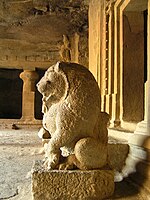
Left: The four-armed doorkeeper and (right) the leogriff figure
Several courtyards to the east and west of the main cave are blocked, though there is a 17 m (56 ft)-wide courtyard that is accessible by entering the eastern part and climbing nine steps. A temple on the southern wall of the court depicts a well-preserved fresco. The circular pedestal seen in the courtyard in front of the Shiva's shrine near the east end, in the open area, is said to be the seat of Nandi, Shiva's mount.
On each side of the steps leading to the temple-cave portico is a winged lion, or leogriff, each seated with a raised forepaw. The portico has chambers at each end and a Linga-shrine at the back. Five low steps and a threshold lead into the central Linga-shrine which is 4.2 m (14 ft) wide and 5 m (16 ft) deep and has a circumambulatory path (Pradakshina-path) around it. At the back of the portico, near the east end, is a gigantic statue of a four-armed doorkeeper with two attendant demons. At the north end is a standing figure holding a trident. His left hand rests on a defaced demon-figure. The west wall depicts the Ashta-Matrikas (eight mother goddesses), flanked by Kartikeya and Ganesha, the sons of Shiva. Some of Matrikas are depicted with children, but all of them are shown by their respective mounts (bull, swan, peacock, a Garuda, etc.) which identify them. At the east end of the portico is another chapel with a plain interior and sunken floor. Water drips in this chapel.
West wing[edit]
The west wing, entered through the main cave, is in a semi-ruined state. It has a small chapel and a cistern enclosed within the pillared cave, which is believed to be Buddhist. Another shrine to the west of the courtyard, with a portico, has carvings of Shiva in a yogic pose seated on a lotus carried by “two fat, heavy, wigged figures”. This carving also depicts a three-faced bearded Bramha and several other figurines. Entering through the back door of the portico is a cave enshrined with a multifaceted Shiva Linga erected over roughly hewn salunkhs. At the door entrance on both flanks, statues of gatekeepers standing over demons and two fat, poised figures are seen. On the southern side of the door is an ensemble of a number of statues. Prominent among these is the Shiva carving, which is depicted with six arms and the third eye in the forehead. Though in a partly ruined state, the carving shows Shiva with an ornamented crown fixed with a crescent, seen carrying a cobra in the left hand, a club in another hand, and discerned to be in a dancing pose. Next to this image are a figure under a plantain tree and a Shiva image (Yogishvara) seated on a lotus. Also seen in the panel are a male figure riding a bull with a bell fastened to its neck, a female figure and another carving to left of Shiva, a female figure with a jewel on her forehead with neatly looped headdress, Indra riding an elephant, Vishnu with four arms, holding a discus in one of his left hands and riding on Garuda flanked by a small flying figure, and a male figure with crescent in his hair.
Other notable caves[edit]

One of the other caves.
To the south-east of the Great Cave is the second excavation, which faces east-northeast. It includes a chapel at the north end. The front of this cave is completely destroyed; only fragments of some semi-columns remain. The interior has suffered water damage. The portico is 26 m (85 ft) long and 11 m (36 ft) deep. The chapel is supported by eight eight-cornered columns and two demi-columns and is irregular in shape. At the back of the portico are three chambers; the central one has an altar and a water channel (pranalika), though the Linga is lost. The shrine door has some traces of sculpture (a boy, a fat figure, alligators on the frieze, and broken animal figures at the head of a doorjamb). The door-keepers of the shrine are now in fragments.
A little to the south of the last cave is another cave in worse condition, with water damage. It is a portico in which each end probably had a chapel or room with pillars in front. Two of them have cells at the back. The central door at the back of the portico leads to a damaged shrine. The shrine door has door-keepers at each side, leaning on dwarfs with flying figures over the head, with door-keepers and demons on the jamb and architrave. The shrine is a plain room 6 m (20 ft) deep by 5.7 m (19 ft) wide with a low altar, holding a Linga. South of this cave is a cavern that may be used as a cistern.
Above these caves is a tiger sculpture, which was worshipped as the tiger goddess Vaghesheri. This sculpture may be a guardian of the north entrance of Cave 1. A Linga is also found near a small pond at top of the hill. Sculptures depicting a stone with a sun and a moon and a mother suckling a child (now moved) were also found nearby.
Across the top of the ravine from Cave 1 is large hall known as Sitabai's Temple (cave). The portico has four pillars and two pilasters. The hall has 3 chambers at the back, the central one a shrine and the rest for priests (both are plain rooms). The door of the central shrine has pilasters and a frieze, with the threshold having lion figures at the end. The shrine has an altar, a water channel, and hole in the centre, in which a statue of Parvati may have been worshipped. A 17th-century record states that "this cave [has] a beautiful gate with a porch of exquisitely wrought marble" and two idols, one of goddess Vetal Candi and a head being in a large square seat.
Passing along the face of the eastern hill to the north of Sitabai's cave is a small Hindu excavation with a veranda, which was probably to be three cells, but was abandoned following the discovery of a flaw in the rock. Towards the east of hill is a dry pond, with large artificial boulders and Buddhist cisterns along its banks. At the end of the north spur of the main hill is a mound that resembles a Buddhist stupa.
Preservation[edit]

Tourists taking pictures of the Trimurti
The threats to Elephanta Caves have been identified as the following: developmental pressures (mainly due to its location within the Mumbaiharbour), anthropogenic pressure due to growth of population of the communities residing on the island, industrial growth of the port facilities close to the island, no risk preparedness plan to address natural calamities such as earthquake, cyclones and terrorist attacks, unsustainable tourism and tourist facilities on the island, and poor management of the heritage monument.
Preservation of Elephanta Island as a whole with its monuments has been ensured both through legislation and by physical restoration of the caves and its sculptures. The basic legislations enacted are: The Ancient Monuments and Archaeological Sites and Remains Act of 1958 and Rules (1959); The Elephanta Island (Protected Monument) Rules of 1957, which prohibits mining, quarrying, blasting, excavation and other operations near the monument; the Antiquities and Art Treasures Act promulgated in 1972 with its Rules promulgated in 1973; a Notification issued in 1985 declaring the entire island and a 1-kilometre (0.62 mi) area from the shore as "a prohibited area"; a series of Maharashtra State Government environmental acts protecting the site; the 1966 Regional and Town Planning Act; and the 1995 Heritage Regulations for Greater Bombay.
The Archaeological Survey of India (ASI), Aurangabad Circle, on the basis of the above legislation and rules, maintain and manage the monuments. The physical measures undertaken for conservation cover include stabilisation of the rock face, construction of supports to the cave structures where pillars have collapsed, and consolidation of cave floors and construction of a parapet wall surrounding the site. In addition, visitor facilities at the site have been upgraded (such as toilet facilities, railing construction, pathways, and a flight of steps from the jetty to the caves). An on-site museum has been established and a conservation plan has been put in place. Overall, conservation of the property is stated to be good. The site receives approximately 25,000 visitors per month. Public information brochures are also available at the venue of the monuments. During the World Heritage Day on 18 April and World Heritage Week between 19 and 25 November there are special events held at the caves. Another popular event organised is an annual traditional dance festival that attracts many visitors.
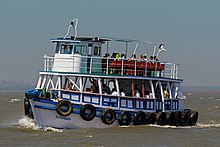
A typical boat that runs betweenApollo Bunder and Elephanta Island.
After declaring the caves a World Heritage Site, UNESCO granted $100,000 to document the site's history and draw up a site plan. A part of the grant was used for conservation of the caves. Based on assessments by UNESCO, management plans include: better communication and collaboration between the ASI, on-site staff, and other responsible government departments; improved public information and awareness programs; monitoring environmental impact of tourists on the cave and island environment; greater attention to the maintenance of the rocks to address water leakages into the caves; and daily monitoring of both structural and chemical conservation measures.
The Indian National Trust for Art and Cultural Heritage (INTACH) is also involved with the Archaeological Survey of India in improving the local conditions at the cave site. A book has been published jointly by UNESCO, INTACH and the Government of India which presents a comprehensive site plan for restoration and a brief history of each sculpture constructed inside the caves.
Udayagiri Caves
From Wikipedia, the free encyclopedia
Not to be confused with Udayagiri and Khandagiri Caves near Bhubaneswar, Odisha.

Udayagiri hills from the east
Udayagiri Caves
archaeological site

Udayagiri, Cave 5, Viṣṇu as the Varāha Avatar, general view
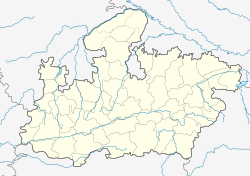

Udayagiri CavesLocation in Madhya Pradesh, India
Coordinates: 23.536389°N 77.772222°ECoordinates: 23.536389°N 77.772222°E
Country India
India
State Madhya Pradesh
District Vidisha
Languages
• Official Hindi
Time zone IST (UTC+5:30)
PIN 464001
The Udayagiri Caves feature some of the oldest Hindu images and cave temples in India.[1][2] They are located near the city of Vidisha, northeast of Bhopal in the state ofMadhya Pradesh.[2] One of India's most important archaeological sites from the Gupta period, the Udayagiri hills and its caves are an archaeological site under the protection of the Archaeological Survey of India.
Udayagiri consists of two low hills immediately next to the River Bes. Located a short distance from the earthen ramparts of the ancient city site of Besnagar, Udayagiri is about 4 km from the town of Vidisha and about 13 km from the Buddhist site of Sanchi.[3] Udayagiri is best known for a series of rock-cut sanctuaries and images excavated into hillside in the early years of the fifth century CE. The site is notable for its ancient monumental relief sculpture of Hindu god Vishnu, in his incarnation as the boar-headed Varaha, rescuing the earth symbolically represented by Bhudevi clinging to the boar's tusk as described in Hindu mythology.[1] The site has important inscriptions of theGupta dynasty belonging to the reigns of Chandragupta II (c. 375-415) and Kumaragupta I (c. 415-55).[4] In addition to these remains, Udayagiri has a series of rock-shelters and petroglyphs, ruined buildings, inscriptions, water systems, fortifications and habitation mounds, all of which have been only partially investigated. The complex consists of twenty caves, of which one is dedicated to Jainism and all others to Hinduism.[2]
There are a number of places in India with the same name, the most notable being the mountain called Udayagiri at Rajgir inBihar and the Udayagiri and Khandagiri Caves in Odisha.
Etymology[edit]
The name of the site in ancient times is not directly attested. Udayagiri, literally means the 'mountain of the sunrise', first appears in inscriptions of the eleventh century and it is now the name attached to a small village at the foot of the hill. Some historians have suggested that the iron pillar at Delhi originally stood at Udayagiri.[5] If true, the inscription on the pillar shows that Udayagiri was called Viṣṇupadagiri, the 'hill of Viṣṇu's foot-prints' in the fifth century CE. This is supported by an inscription in one of the Udayagiri caves (Cave 19) reporting that the devotee who repaired the shrine 'bows forever to the feet of Viṣṇu'.[6]
History[edit]

A Gupta coin depicting Chandragupta II, now in theBritish Museum, London.
The site at Udayagiri Caves was extensively reworked under the patronage of Chandragupta II, who ruled the Gupta Empire between c. 380 and 413/415 CE. Archaeologist Michael D. Willis argued that Chandragupta II did so in order to reflect a new concept of Hindu kingship, in which the monarch was seen as both the paramount sovereign (cakravartin) and the supreme devotee of the god Vișņu (paramabhāgavata).[7]
Caves, sculptures and inscriptions[edit]
The caves at Udayagiri were numbered in the nineteenth century from south to north by Alexander Cunningham but a more detailed system was introduced by the Department of Archaeology, Gwalior State.[8] Due to the changes, the exact numbering sequence is debated, in part because many of the caves are little more than shallow niches or empty chambers. Most visitors will be interested in the sculptures, architecture and inscriptions found at Caves 1, 3, 4, 5, 6 and 13, the numbering of which is now generally accepted.
Cave 1[edit]
Cave 1, the only substantial residue on the southern part of Udayagiri hill, has a frontage adapted out of a natural ledge of rock, thus forming both the root of the cave and its portico. The row of four pillars bear the ‘vase and foliage’ pattern of which the eminent art historian Percy Brown so eloquently says: “the Gupta capital typifies a renewal of faith, the water nourishing the plant trailing from its brim, and allegory which has produced vase and flower motif, one of the most graceful forms in Indian architecture”.[citation needed]
Cave 3 : Dedicated to Skanda[edit]

Udayagiri, Cave 4, Śiva liṅga
Cave 3 is the first of the central group or cluster of shrines and reliefs. It consists of an irregularly finished cella with a plain entrance. Traces of two pilasters are seen on both sides of the entrance and there is a deep horizontal cutting above which shows that there was some sort of portico in front of the shrine. Inside there is a rock-cut image of Kārttikeya or Skanda, the war god, on a monolithic plinth. The mouldings and spout of the plinth are now damaged. The figure, with an impressive muscular torso, stands with his weight equally on both legs; one of the hands holds the remains of a staff or club. The broad square face is typical of the early fifth-century style of figural sculpture.[9]
Cave 4 : Dedicated to Śiva in the form of a liṅga[edit]
Cave 4 has a rectangular cella with a rock-cut plinth in which is set a spectacular Śiva linga. The hair is tied up into a topknot with long locks cascading down each side. The arrangement of the hair recalls the story of how Śiva broke the fall of the River Gaṅgā as the waters came down from heaven. There is a water channel in the plinth and in the floor of the chamber leading to a hole that pierces in the cave wall. The cave is entered through an entrance of exquisite proportions with delicately carved floral scrolls. The lintel of the door extends beyond the jambs to create a T-shape, a common characteristic of early temple architecture. Unlike most doors, however, the frame consists only of square moulding, identical on the top and sides. The base of the jambs and the sill are modern replacements. Externally, the cave is flanked by rock-cut pilasters and two guardians (dvārapāla) now damaged and weather-worn.[citation needed]
Cave 5: Varāha[edit]

Cave 5, Viṣṇu as Varāha, showing god controlling the waters, personified as a serpent (nāga), and carrying the earth goddess on his tusk.
Cave 5 is a shallow niche more than a cave and contains the much-celebrated figure of Viṣṇu in his Varāha or Boar-headed incarnation. The complex iconography of the tableau has been explained by Debala Mitra.[10] Willis has described the relief as the "iconographic centre-piece of Udayagiri".[11]
Cave 6[edit]
Cave 6 is directly beside Cave 5 and consists of rock-cut cella entered through an elaborate T-shaped door. The original image inside is missing but it was probably a Śiva liṅga. Outside the cave is a panel with an inscription recording the creation of the 'meritorious gift' (deyadharma), probably the cave and the adjacent images, in Gupta year 82 (401 CE).[12] In the ceiling of the cave is an undated pilgrim record of somebody named Śivāditya.[13]

Udayagiri, Cave 6, detail showing Dvārapāla, Viṣṇu and Gaṇeśa
The door guardians flanking the entrance are regarded by art historians as among the most powerful works of early Gupta sculpture. Beside them, on either side, are figures of Viṣṇu and of Śiva Gaṅgādhāra, the latter much worn from the falling of water over the image. Of special note is Durgā slaying the Buffalo Demon, one of the earliest representations of the theme in India.[14] Of special note also is the figure of seated Gaṇeśa, to the left of the cave entrance, and the rectangular niche with seated goddesses, located to the right. Aside from this being the oldest datable Gaṇeśa in India, the arrangement, with a guarded sanctum in the centre, Gaṇeśa on one side and the mother goddesses on the other, presages the arrangement of temple space in subsequent centuries.[15]

Udayagiri, Cave 8, exterior from the north east.
Cave 8 : Dedicated to Śiva by the king's minister Vīrasena[edit]
Cave 8 is slightly to the north and east of the Cave 6 cluster. It is excavated into a dome-shaped rock surmounted by massive horizontal slab. The curious form was created by the natural erosion of the rock over time (the ashlar supports of the slab were added sometime in the 1930s by the Department of Archaeology, Gwalior State). Two abraded figures guard the entrance to the inner chamber. Inside, the cave is empty apart from a lotus carved in the ceiling and a damaged inscription on the back wall. The inscription is a record of great historical importance. It states, in anuṣṭubh verse, that the work was composed by Vīrasena, the king's minister, and that he had come here (iha, i.e. Udayagiri) in the company of Chandragupta II who was engaged in a campaign of world conquest.[16] Amongst all the Gupta inscriptions and antiquities, this is the only record that documents the actual presence of a Gupta king at a particular place.

Udayagiri, view of the central passage, looking west
The Passage[edit]
The Passage, which starts beside Cave 8, is a unique feature of Udayagiri. It consists of a natural cleft or canyon in the rock running approximately east to west. The passage has been subject to series of modifications and additions, the sets of steps cut into the floor being the most conspicuous feature. The lowest set of steps on the right hand side is visibly water-worn and evidently served as a water-cascade in historic times. Shell inscriptions (so-called by modern epigraphy specialists because of their shell-like shape) engraved on the upper walls of the passage are the largest examples of this kind of writing known in India. The images of the fifth century cut through the Sankha Lipiindicating they pre-date Gupta times. The inscriptions, which appear to be names in Sanskrit, had not been fully deciphered until recently.[17] The upper walls of the passage have large notches at several places, indicating that stone beams and slabs were used to roof over parts of the passage, giving it a significantly different appearance from what can be seen today. In terms of sculpture, the passage has a series of niches and caves, numbered 9 through 14. Only a few contain sculptures, mostly of standing Viṣṇu, all of which are damaged.
Cave 12[edit]
Cave 12 consists of a niche containing a standing figure of Narasimha or Nṛsiṃha, Viṣṇu in his 'Lion-man' incarnation. Below on either side are two small standing attendant figures. The images cut through a shell character about two meters in height. In the floor below Nṛsiṃha there is a short Brahmī inscription.

Udayagiri, Cave 13, detail of the recumbent figure of Nārāyaṇa
Cave 13 : Sleeping Nārāyaṇa[edit]
Cave 13 contains a large figure of Nārāyaṇa, the recumbent figure of Viṣṇu resting. Before the niche are two shallow recess in the floor. These received pillar bases for some sort of porch. There is a shallow vertical recess above the cave, matched by a similar recess in the opposite cliff face, suggesting that there was some sort of architectural curtain wall across the passage at this point. The cave has received a modern in screen, a great disfigurement.[citation needed]
Beside the image of Nārāyaṇa is a kneeling devotee, and it has been argued that this figure is a depiction of Chandragupta II himself, symbolising his devotion to Viṣṇu.[18]
Cave 14[edit]
Cave 14, the last cave on the left hand side at the top of the passage. It consists of a recessed square chamber of which only two sides are preserved. The outline of the chamber is visible in the floor, with a water channel pierced through the wall on one side as in the other caves at the site. One side of the doorjamb is preserved, showing jambs with receding faces but without any relief carving.
Political and historical allegory[edit]
In an academic paper on historical and political allegory in Gupta art published in 1983, Frederick M. Asher argued that the depiction of Vāraha at Udayagiri symbolised the unification of Northern India under the rule of Chandragupta II. In this way, Asher argued that Vāraha's rescue of the Earth from the chaos of the cosmic sea echoed Chandragupta II's rescue of Northern India from the political instability and fragmentation that it had experienced prior to the rise of the Gupta Empire.[19] Across much of India during this period, Vāraha had been used as a symbol of royalty, but Asher opined that "nowhere is the allegory stated in such magnificent visual terms" as at Udayagiri.[20]
Asher identified further potential political allegories in two figures depicted on one of the two projecting walls, who were female personifications of Gaṅgā and Yamunā, the rivers that flowed through the heartland of the Gupta Empire. Asher suggested that while these two figures were here depicted flowing into the primeval ocean, Ekavarṇa, from which Vāraha saved the Earth, they also carried with them further political allegory. In Sanskrit, the word for ocean is samudra, and so Asher suggested that to people of the time this might have recalled the name of Samudra Gupta, Chandragupta II's father, who merged many kingdoms into his empire in the same way that the two rivers merged into the ocean.[21] Although not rejecting them, the scholar Michael D. Willis expressed caution in accepting Asher's theories here.[22]
See also[edit]
===========================================================================
Badami cave temples
From Wikipedia, the free encyclopedia
(Redirected from Badami Cave Temples)
Badami cave temples

Vishnu image in Badami cave 3
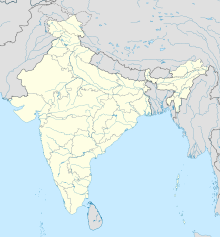
Location of the cave in India
Location Badami, Karnataka
Coordinates15°55′06″N 75°41′06″ECoordinates: 15°55′06″N 75°41′06″E
Discovery 6th Century
Geology Sandstone
Entrances Six caves
Difficulty Easy
Features UNESCO world heritage site candidate[1]
The Badami cave temples are a complex of four Hindu, Jain and possibly Buddhist cave temples located in Badami, a town in theBagalkot district in northern part of Karnataka, India. The caves are considered an example of Indian rock-cut architecture, especiallyBadami Chalukya architecture, which dates from the 6th century. Badami was previously known as Vataapi Badami, the capital of the early Chalukya dynasty, which ruled much of Karnataka from the 6th to the 8th century. Badami is situated on the west bank of an artificial lake ringed by an earthen wall with stone steps; it is surrounded on the north and south by forts built in later times.
The Badami cave temples represent some of the earliest known examples of Hindu temples. UNESCO has described the designs of the Badami cave temples, and those in Aihole, as having transformed the Malaprabha River valley into a cradle of temple architecture that defined the components of later Hindu temples elsewhere in India.
Caves 1 to 4 are in the escarpment of the hill in soft Badami sandstone formation, to the south-east of the town. In Cave 1, among various sculptures of Hindu divinities and themes, a prominent carving is of the Tandava-dancing Shiva as Nataraja. Cave 2 is mostly similar to Cave 1 in terms of its layout and dimensions, featuring Hindu subjects of which the relief of Vishnu as Trivikrama is the largest. The largest cave is Cave 3, featuring Vishnu-related mythology, and it is also the most intricately carved cave in the complex. Cave 4 is dedicated to revered figures of Jainism. Cave 5 may be a Buddhist cave. Another cave was discovered in 2015, about 500 metres (1,600 ft) from the four main caves, with 27 Hindu carvings.
Contents [hide]
1Geography
2History
3Temple caves
3.1Cave 1
3.2Cave 2
3.3Cave 3
3.4Cave 4
3.5Cave 5
3.6Other caves
4See also
5References
6Bibliography
7External links
Geography[edit]
The Badami cave temples are located in the town of Badami in the north-central part of Karnataka, India. The temples are about 70 miles (110 km) north-east of Hubli-Dharwad, the second-largest metropolitan area of the state. The Malaprabha River is 3 miles (4.8 km) away. Badami, also referred to as Vatapi, Vatapipuri and Vatapinagari in historical texts,[2] the capital of Chalukya dynasty in the 6th century, is at the exit point of a ravine between two steep mountain cliffs. Four cave temples in the escarpment of the hill to the south-east of the town have been excavated. The escarpment is above an artificial lake called Agastya Lake that is created by an earthen dam faced with stone steps. To the west end of this cliff, at its lowest point, is the first cave temple.[3][4] The largest cave is Cave 3, which is further to the east on the northern face of the hill.[5] The fourth cave, Cave 4, is a short distance away.[2][6][7]
History[edit]

Epigraphy in the Kannada language (c. 578}) dating the carving of Cave 3
The cave temples, numbered 1 to 4 in the order of their creation, in the town of Badami – the capital city of the Chalukya kingdom (also known as Early Chalukyas[4]) – are dated from the late 6th century onwards. The exact dating is known only for Cave 3, which is a temple dedicated to Vishnu. An inscription found here records the creation of the shrine by Mangalesha in Saka 500 (lunar calendar, 578/579 CE).[8] The inscription, written in the Kannada language,[2][9] has enabled the dating of these rock cave temples to the 6th century.[2][10][11]
The Badami caves complex is part of a UNESCO-designated World Heritage Site candidate under the title "Evolution of Temple Architecture – Aihole-Badami-Pattadakal" in the Malaprabha river valley, considered a cradle of temple architecture that formed the model for later Hindu temples in the region.[6][1] The artwork in Caves 1 and 2 exhibit the northern Deccan style of the 6th and 7th centuries, while those in Cave 3 simultaneously represent two ancient Indian artistic traditions; the northern Nagara and the southern Dravidastyles.[12][13] Cave 3 also shows icons and reliefs in the Vesara style, a creative fusion of ideas from the two styles, as well as some of the earliest surviving historical examples in Karnataka of yantra-chakra motifs (geometric symbolism) and colored fresco paintings.[14][15][16] The first three caves feature sculptures of Hindu icons and legends focusing on Shiva and Vishnu,[17] while Cave 4 features Jain icons and themes.[18]
Temple caves[edit]

Caves on the cliff above Agastya Lake
The Badami cave temples are man-made, all carved out of soft Badami sandstone on a hill cliff.[10] The plan of each of the four caves (1 to 4) includes an entrance with a verandah (mukha mandapa) supported by stone columns and brackets, a distinctive feature of these caves, leading to a columned mandapa, or main hall (also maha mandapa), and then to the small, square shrine (sanctum sanctorum,garbhaghrha) cut deep inside the cave.[19] The cave temples are linked by a stepped path with intermediate terraces overlooking the town and lake. The cave temples are labelled 1–4 in their ascending series; this numbering does not reflect the sequence of excavation.[20]
The architecture includes structures built in the Nagara and Dravidian styles, which is the first and most persistent architectural idiom to be adopted by the early chalukyas.[20] There is also a fifth natural cave temple in Badami, a Buddhist temple, a natural cave that can only be entered by crouching on all fours.[21]
Cave 1[edit]
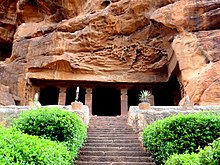
Entrance to Cave 1
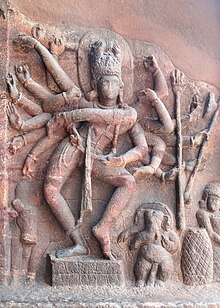
Nataraja or Dancing Shiva in Cave 1
Cave 1 is about 59 feet (18 m) above ground level on the north-west part of the hill. Access is through a series of steps that depict carvings of dwarfish ganas (with bovine and equine heads) in different postures.[22] The verandah, with an inner measurement of 70 feet (21 m) by 65 feet (20 m), has four columns sculpted with reliefs of the god Shiva shown in dancing positions and incarnations.[23] The guardian dwarapalas (door keepers) at the entrance to the cave measure 6.166 feet (1.879 m).[22]
The cave portrays the Tandava-dancing Shiva as Nataraja.[23][24][17] The image, 5 feet (1.5 m) tall, has 18 arms in a form that expresses the dance positions arranged in a geometric pattern, which Alice Boner – a Swiss art historian and Indologist, says is a time division symbolizing the cosmic wheel.[17] While most of the arms express mudras (symbolic hand gestures),[25] some of the arms hold objects such as drums, a trident and an axe; some also have serpents coiled around them. Shiva has his son Ganesha and the bull Nandi by his side. Adjoining the Nataraja, one wall depicts the goddess Durga,[22] who is depicted slaying the buffalo-demon Mahishasura. Elsewhere, the sons of Shiva, Ganesha and Kartikkeya, the god of war and family deity of the Chalukya dynasty, are seen in one of the carved sculptures on the walls of the cave, with Kartikkeya riding a peacock.[22][23]
The cave also has carved sculptures of the goddesses Lakshmi and Parvati flanking Harihara, a 7.75-foot (2.36 m) high sculpture of a fused image that is half-Shiva and half-Vishnu.[24] To the right, toward the end of the wall, is a relief sculpture of Ardhanarishvara, a composite androgynous form of Shiva and his consort Parvati along with a female decorated goddess holding a flat object in her left hand; Nandi, the bull and Bhringi, a devotee of Shiva.[26][24]
All the figures are adorned with carved ornaments and surrounded by borders with reliefs of animals and birds. The lotus design is a common theme. On the ceiling are images of the Vidyadhara couples. Through a cleft in the back wall of the cave is a square sanctuary with more carved images.[23]
The roof of the cave has five carved panels with the central panel depicting the serpent Shesha. The head and bust are well formed and project boldly from the centre of the coil. In another compartment a bas-relief 2.5 feet (0.76 m) in diameter has carvings of a male and female; the male is Yaksha carrying a sword and the female is Apsara with a flying veil. The succeeding panel has carvings of two small figures and the panel at the end is carved with lotuses.[27]
Cave 2[edit]

Plan of Badami Cave 2, dedicated to Vishnu[28]
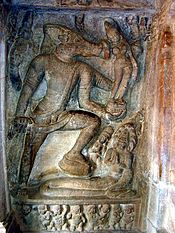

Left: Vishnu as Varaha rescuing Earth as Bhudevi. Right: Frieze at Cave 2 entrance
Cave 2, lying to the west of Cave 3[29] and facing north, was created in late 6th century. It is almost same as Cave 1 in terms of its layout and dimensions, but it is dedicated primarily to Vishnu. Cave 2 is reached by climbing 64 steps from the first cave. The cave entrance is a verandah divided by four square pillars, which has carvings from its middle section to the top where there are yali brackets with sculptures within them. The cave is adorned with reliefs of guardians. Like Cave 1, the carved cave art is a pantheon of Hindu divinities.[10][29]
The largest relief in Cave 2 shows Vishnu as Trivikrama (Vamana), with one foot on Earth and another directed to the north.[10] Other representations of Vishnu in this cave include Varaha (a boar) shown rescuing Bhudevi (a symbol of the earth) from the depths of the ocean; and Krishna avatars, legends found in Hindu Puranas texts such as the Bhagavata Purana.[17][30] Like other major murti (forms) in this and other Badami caves, the Varaha sculpture is set in a circle; according to Alice Boner, the panel is an upright rectangle whose "height is equal to the octopartite directing circle and sides are aligned to essential geometric ratios, in this case to the second vertical chord of the circle".[17]
The doorway is framed by pilasters carrying an entablature with three blocks embellished with gavaksha ornament.[31] The entrance of the cave also has two armed guardians holding flowers rather than weapons. The end walls of the outer verandah are adorned with sculpted panels: to the right, Trivikrama and to the left, Varaha rescuing Bhudevi, with a penitent multi-headed snake (Nāga) below. The adjacent side walls and ceiling have traces of colored paint, suggesting the cave used to have fresco paintings.[10] The columns show gods and battle scenes; the churning of the cosmic ocean (Samudra Manthan); Gajalakshmi and figures; Brahma; Vishnu asleep on Shesha; illustrations of the birth of Krishna; Krishna's youth; Krishna with gopis; and cows.[10][29]
The ceiling of Cave 2 shows a wheel with sixteen fish spokes in a square frame along with swastikas and flying couples. The end bays have a flying couple and Vishnu on Garuda.[10] The main hall in the cave is 33.33 feet (10.16 m) wide, 23.583 feet (7.188 m) deep, and 11.33 feet (3.45 m) high and is supported by eight square pillars in two rows. The roof of this hall has panels filled with bas-relief carvings. At the upper reaches of the wall, a frieze runs all along the wall with engravings of episodes from the Krishna or Vishnu legends.[29]
The sculptures of Cave 2, like Cave 1, are of the northern Deccan style of the 6th and 7th century similar to that found in Ellora caves.[12]
Cave 3[edit]


Left: Cave 3 is the largest, and dedicated to Vishnu. Right: Vishnu seated on serpent Sesha
Cave 3 is dedicated to Vishnu; it is the largest and most intricately carved cave in the complex. It has well carved, giant figures of Trivikrama, Anantasayana, Paravasudeva, Bhuvaraha (Varaha), Harihara and Narasimha.[10]Cave 3's primary theme is Vaishnavite, though it also shows Harihara on its southern wall – [32] half Vishnu and half Shiva shown fused as one, making the cave important to Shaivism studies.[9][33]
Cave 3, also facing north, is 60 steps away from Cave 2. Cave 3's temple's verandah is 70 feet (21 m) in length with an interior width of 65 feet (20 m); it has been sculpted 48 feet (15 m) deep into the mountain; an added square shrine at the end extends the cave 12 feet (3.7 m) further inside.[34] The verandah itself is 7 feet (2.1 m) wide and has four free-standing, carved pillars separating it from the hall. The cave is 15 feet (4.6 m) high; it is supported by six pillars, each measuring 2.5 square feet (0.23 m2).[35] Each column and pilaster is carved with wide, deep bases crowned with capitals that are partly hidden by brackets on three sides. Each bracket, except for one, has carvings of human figures standing under foliage in different postures, of male and female mythological characters, and an attendant figure of a dwarf. A moulded cornice in the facia, with a dado of blocks below it (generally 7 feet (2.1 m) long), has about thirty compartments carved with series of two fat dwarves called ganas.[35] The cave shows a Kamascene on one pillar, where a woman and a man are in maithuna (erotic) embrace beneath a tree.[36]
Cave 3 also shows fresco paintings on the ceiling, some of which are faded, broken and unclear. These are among the earliest known surviving evidence of fresco painting in Indian art.[15] The Hindu god Brahma is seen in one of the murals; the wedding of Shiva and Parvati, attended by various Hindu deities, is the theme of another.[37] There is a lotus medallion on the floor underneath the mural of the four-armed Brahma. The sculpture is well preserved, and a large number of Vishnu's reliefs including standing Vishnu with eight arms; Vishnu seated on the hooded serpent Shesha on the eastern side of the verandha; Vishnu as Narasimha (half human, half lion); Varaha fully armed[17] in the back wall of the cave; Harihara (a syncretic sculpture of Vishnu and Shiva); and Trivikrama avatars. The back wall also has carvings of Vidhyadharas holding offerings to Varaha; adjoining this is an inscription dated 579 AD with the name Mangalis inscribed on it.[8]
At one end of the pilaster is a sculpture of Vamana shown with eight arms (Ashtabhuja); this is decorated with various types of weapons. A crescent moon is crafted above his face and the crown of Vishnu decorates his head. He is flanked by Varaha and two other figures; below on his right is his attendant Garuda. The images in front of Vamana are three figures of Bali and his wife with Shukra, his councillor.[38][39] Reliefs stand 4 metres (13 ft) tall. Some aspects of the culture and clothing in the 6th century is visible in the art sculpted in this cave.[40] The roof of the verandah has seven panels created by cross beams; each is painted in circular compartments with images of deities including Shiva, Vishnu, Indra, Brahma and Kama, with smaller images of Dikpalas (cardinal guardians) with geometric mosaics filling the gaps at the corners.[41]
The roof of the front aisle has panels with murals in the centre of male and female figurines flying in the clouds; the male figure is yaksha holding a sword and a shield. Decoration of lotus blooms are also seen on the panels. The roof of the hall is divided into nine panels slightly above the level of the ceiling. The central panel here depicts a devamounted on a ram – conjectured to be Agni. Images of Brahma and Varuna are also painted on the central panels; the floating figures are seen in the remaining panels.[29]
Cave 4[edit]


Left: Tirthankara Parshvanath. Right: Mahavira in Jain Cave 4
Located to the east of Cave 3, Cave 4 is situated higher than the other caves. It is dedicated to revered figures ofJainism and is the most-recently constructed of the caves. Like the other caves, it features detailed carvings and a diverse range of motifs.[18][42] The cave has a five-bayed entrance with four square columns – each with brackets and capitals. To the back of this verandah is a hall with two standalone and two joined pillars. The first aisle is a verandah 31 feet (9.4 m) long by 6.5 feet (2.0 m) wide, extending to 16 feet (4.9 m) deep. From the hall, steps lead to the sanctum sanctorum, which is 25.5 feet (7.8 m) wide extends to a depth of 6 feet (1.8 m).[42]
On the back part of this, Mahavira is represented sitting on a lion throne;[43][42] this figure is flanked by bas-reliefs of attendants with chauri (fans), sardulas and makara's heads. The end walls have Parshvanath about 7.5 feet (2.3 m) tall with his head decorated with a multi-headed cobra representing protection and reverence.[42] Carvings includeIndrabhuti Gautama covered by four snakes, and Bahubali seen to the left of Gautama with his lower legs surrounded by snakes, together with his daughters Brahmi and Sundari. [44][42] In the sanctum is an image of Mahavira resting on a pedestal containing a 12th-century Kannada inscription marking the death of one Jakkave. Many Jaina Tirthankara images have been engraved on the inner pillars and walls. In addition there are idols ofYakshas, Yakshis, Padmavati and other Tirthankaras. Most scholars believe Cave 4 was created in the mid-7th century, but some place its creation in the 8th century.[44]
Cave 5[edit]
Cave 5 is an as-yet-undated, natural cave of small dimensions that is approached by crawling due to its narrow opening.[21] Inside, there is a carved statue seated over a sculpted throne with reliefs showing people holding chauris (fans), a tree, elephants, and lions in an attacking pose. The face of this statue was reasonably intact until about 1995,[21] it is now damaged and missing parts.[45]
There are several theories as to who the statue represents. One theory holds that it is a relief of the Buddha in a sitting posture.[45] According to this theory, those holding thechauris are Bodhisattvas flanking the Buddha. In the intervening centuries, the cave was converted to a Hindu shrine of Vishnu, as is seen from the white, religious markings painted on the face of the Buddha as the ninth incarnation of Vishnu.[45][46] According to B.V. Shetti – archaeologist and curator of Prince of Wales Museum of Western India,[47]the cave was not converted but from the start represented a tribute to Mayamoha of the Hindu Puranas, or Buddhavatara Vishnu, its style suggesting it was likely carved in or before the 8th century.[21]
A second theory, found in colonial-era texts such as one by John Murray – a missionary in British India and Jainism scholar,[48] say the main image carved in Cave 5 is that of a Jaina figure.[49] According to a third theory, by Henry Cousens and A. Sundara – archaeologists, and supported by local legends, the statue is of an ancient king; in a photograph of the statue taken before its face was damaged, the figure lacked the Ushnisha lump that typically goes with Buddha's image. The statue has several unusual, non-Buddha ornaments such as rings for fingers, a necklace and a chest-band; it wears a Hindu Yajnopavita thread and its head is stylistically closer to a Jin head than a Buddha head.These features suggest the statue may be of a king represented with features of various traditions. According to Carol Radcliffe Bolon – Assistant Curator at the Smithsonian Freer Gallery of Art, the date and identity of the main statue in Cave 5 remains enigmatic.
Other caves
In 2013, Manjunath Sullolli – Assistant Director of Bagalkot district working for the state government of Karnataka, reported the discovery of another cave with 27 rock carvings, about 500 metres (1,600 ft) from the four main caves. Water gushes from this newly discovered cave year round. It depicts Vishnu and other Hindu deities, and features an inscription in the Devanagari script. The dating of these carvings is unknown.
সম্পূর্ণ তথ্য ইন্টারনেট থেকে সংগ্রহ করা
<---©-আদ্যনাথ--->
<---©-আদ্যনাথ--->
আমি কিছুদিন ছিলাম বোম্বে হইতে ONGCর জাহাজে তখন কিন্তু জানতাম না এই এলিফেনটা গুহার ব্যাপারে। পরে একদিন দেখলাম ও জানলাম এই এলিফেন্টার ব্যাপারে খবরের কাগজ পড়ে।
আর তখনি মন ব্যাকুল হলো এলিফেন্টা দেখার জন্য।1990 র ডিসেম্বরে সুযোগ ও ছুটি পেলাম ,
আমরা চারজন প্ল্যান করলাম। কিন্তু বিশেষ কোন কারনে ভি সি আর পিল্লাইকে বাড়ি যেতে হল তাই আমরা তিন জন সন্তোষ দত্ত ,হীরামোহন পান্ডে ,ও আমি যাবার জন্য তৈরী হলাম। তখনো ট্রেনের টিকিট কাটা হয়নি। একদিন গেলাম ধানবাদে ট্রেনের টিকিট কাটতে ,স্টেশনে অমিতের সাথে দেখা। অমিত তখন ডিউটিতে ,ধানবাদ স্টেশনের টিকিট কলেক্টর।
অমিত ঘড়াই আমাদের টুরের প্ল্যান শুনে নিজেই রাজিহয়ে গেল আমাদের সাথে যাবার জন্য।
অমিত নিজেই টিকিট কাটার দায়িত্ব নিয়েছিল।
আমরা চারজন যথারিতি বৃহষ্পতিবার 22 নভেম্বর 1990 বোম্বে মেল্ 02:30am এতে রওনা দিলাম।
ট্রেনে দুই রাট কাটিয়ে শনিবার বার দুপুর 12;30 মিটিত নাগাদ আমরা বোম্বে পৌঁছলাম। সেদিন এক হোটেলে থাকলাম বিকেলের দিকে জুহু বিচে ঘুড়ে বেরিয়ে হোটেলে রাত কাটিয়ে সকালে চলে গেলাম গেলাম 'গেটওয়ে অফ ইন্ডিয়া '.সেখান থেকে ফেরিতে এলিফেন্টার জেটিঘাট থেকে টয়ট্রেনে গুহা পর্যন্ত।
আমরা রবিবার 25 নভেম্বর সকাল 10 টা থেকে 5 টা পর্যন্ত ঘুরে দেখলাম গুহা গুলি।
আমরা সত্যি ভাগ্যবান যে এই দিন বিশেষ পোগ্রাম দেখতে পেলাম বিশ্ব হেরিটেজ সপ্তাহ পালনের অনুষ্ঠান। নাচে গানে ও নানান অনুষ্ঠানে সেদিন ছিল অপূর্ব এক দর্শনীয় দিন।
কিন্তু অপূর্ব এই গুহাগুলির বর্ণনা করা আমার পক্ষে সম্ভব নয় ,সেই কারনে সকল কিছু মনে রাখতে ইন্টারনেটের সাহায্য নিলাম।
প্রত্যেক দিন সকাল 9 টা থেকে বিকেল 5 টা পর্যন্ত গুহা দেখার সময়।
আর প্রত্যেক সোমবার গুহা প্রদর্শন সম্পূর্ণ বন্ধ থাকে।
Collection from internet
UNESCO World Heritage SiteElephanta Caves
घारापुरीची लेणी
Name as inscribed on the World Heritage List

20 feet (6.1 m) high Trimurti sculpture
Type Cultural
Criteria
Reference 244 rev
UNESCO region South Asia
Inscription history
Inscription 1987 (11th Session)
History of Elephanta caves
Since no inscriptions on any of the island have been discovered, the ancient history of the island is conjectural, at best. Pandavas, the heroes of the Hindu epic Mahabharata, and Banasura, the demon devotee of Shiva, are both credited with building temples or cut caves to live. Local tradition holds that the caves are not man-made.
"Elephanta caves are a network of sculpted( ভাস্কর্য ) caves located on Elephanta Island, or Gharapuri (literally "the city of caves") in Mumbai Harbour ( পোতাশ্রয়, বন্দর ), 10 kilometres (6.2 mi) to the east of the city of Mumbai in the Indian state of Maharashtra. The island, located on an arm of the Arabian Sea, consists of two groups of caves—the first is a large group of five Hindu caves, the second, a smaller group of twoBuddhist caves. The Hindu caves contain rock cut stone sculptures, representing the Shaiva Hindu sect, dedicated to the LordShiva.
The rock cut architecture of the caves has been dated to between the 5th and 8th centuries, although the identity of the original builders is still a subject of debate. The caves are hewn from solid basalt rock. All the caves were also originally painted in the past, but now only traces remain.
The main cave (Cave 1, or the Great Cave) was a Hindu place of worship until Portuguese rule began in 1534, after which the caves suffered severe damage. This cave was renovated in the 1970s after years of neglect, and was designated a UNESCO World Heritage Site in 1987 to preserve the artwork. It is currently maintained by the Archaeological Survey of India (ASI).
Geography[edit]

Elephanta
Elephanta (Mumbai)

The hills of the Elephanta Islands
Elephanta Island, or Gharapuri, is about 11 km (6.8 mi) east of the Apollo Bunder (Bunder in Marathi means a "pier for embarkation and disembarkation of passengers and goods") on the MumbaiHarbour and 10 km (6.2 mi) south of Pir Pal in Trombay. The island covers about 10 km2 (3.9 sq mi) at high tide and about 16 km2 (6.2 sq mi) at low tide. Gharapuri is small village on the south side of the island. The Elephanta Caves can be reached by a ferry from the Gateway of India, Mumbai, which has the nearest airport and train station.
The cave is closed on Monday.
The island is 2.4 km (1.5 mi) in length with two hills that rise to a height of about 150 m (490 ft). A deep ravine cuts through the heart of the island from north to south. On the west, the hill rises gently from the sea and stretches east across the ravine and rises gradually to the extreme east to a height of 173 m (568 ft). This hill is known as the Stupa hill. Forest growth with clusters of mango, tamarind, and karanj trees cover the hills with scattered palm trees. Rice fields are seen in the valley. The fore shore is made up of sand and mud with mangrove bushes on the fringe. Landing quays sit near three small hamlets known as Set Bunder in the north-west, Mora Bunder in the northeast, and Gharapuri or Raj Bunder in the south.
The two hills of the island, the western and the eastern, have five rock-cut caves in the western part and a brick stupa on the eastern hill on its top composed of two caves with a few rock-cut cisterns. One of the caves on the eastern hill is unfinished. It is a protected island with a buffer zone according to a Notification issued in 1985, which also includes "a prohibited area" that stretches 1 kilometre (0.62 mi) from the shoreline.
The Elephanta caves are "of unknown date and attribution". Art historians have dated the caves in the range of late 5th to late 8th century AD.Archaeological excavations have unearthed a few Kshatrapa coins dated to 4th century AD. The known history is traced only to the defeat of Mauryan rulers of Konkan by the Badami Chalukyas emperor Pulakesi II (609–642) in a naval battle, in 635 AD. Elephanta was then called Puri or Purika, and served as the capital of the Konkan Mauryas. Some historians attribute the caves to the Konkan Mauryas, dating them to the mid-6th century, though others refute this claim saying a relatively small kingdom like the Konkan Mauryas could not undertake "an almost superhuman excavation effort," which was needed to carve the rock temples from solid rock and could not have the skilled labor to produce such "high quality" sculpture.

Caves of Elephanta, c. 1905. Note the broken pillars, which were restored in the 1970s.
Some other historians attribute the construction to the Kalachuris (late 5th to 6th century), who may have had a feudal relationship with the Konkan Mauryas. In an era where polytheism was prevalent, the Elephanta main cave dedicates the monotheism of the Pashupata Shaivism sect, a sect to which Kalachuris as well as Konkan Mauryas belonged.
The Chalukyas, who defeated the Kalachuris as well as the Konkan Mauryas, are also believed by some to be creators of the main cave, in the mid-7th century. The Rashtrakutas are the last claimants to the creation of the main cave, approximated to the early 7th to late 8th century. The Elephanta Shiva cave resembles in some aspects the 8th-century Rashtrakuta rock-temple Kailash at Ellora. The Trimurti of Elephanta showing the three faces of Shiva is akin to the Trimurti of Brahma, Vishnu and Mahesh (Shiva), which was the royal insignia of the Rashtrakutas. The Nataraja and Ardhanarishvara sculptures are also attributed to the Rashtrakutas.

The elephant sculpture from Elephanta is currently installed at theJijamata Udyaan.
এটি ইন্টারনেটে পেলাম ,আমরা কিন্তু এটি দেখিনি। তাই মনে হয় 1990 এর পরে এটি বানিয়েছে।
Later, Elephanta was ruled by another Chalukyan dynasty, and then by Gujarat Sultanate, who surrendered it to the Portuguese in 1534. By then, Elephanta was called Gharapuri, which denotes a hill settlement. The name is still used in the local Marathi language. The Portuguese named the island "Elephanta Island" in honour of a huge rock-cut black stone statue of an elephant that was then installed on a mound, a short distance east of Gharapuri village. The elephant now sits in the Jijamata Udyaan zoo in Mumbai.
Portuguese rule saw a decline in the Hindu population on the island and the abandonment of the Shiva cave (main cave) as a regular Hindu place of worship, though worship on Mahashivratri, the festival of Shiva, continued and still does. The Portuguese did considerable damage to the sanctuaries. Portuguese soldiers used the reliefs of Shiva in the main cave for target practice, sparing only the Trimurti sculpture. They also removed an inscription related to the creation of the caves. While some historians solely blame the Portuguese for the destruction of the caves, others also cite water-logging and dripping rainwater as additional damaging factors. The Portuguese left in 1661 as per the marriage treaty of Charles II of England and Catherine of Braganza, daughter of King John IV of Portugal. This marriage shifted possession of the islands to the British Empire, as part of Catherine's dowry to Charles.
Though the main cave was restored in the 1970s, other caves, including three consisting of important sculptures, are still badly damaged. The caves were designated a UNESCO World Heritage Site in 1987 as per the cultural criteria of UNESCO: the caves "represent a masterpiece of human creative genius" and "bear a unique or at least exceptional testimony to a cultural tradition or to a civilisation which is living or which has disappeared".
গুহার বর্ণনা ------
The island has two groups of caves in the rock-cut architectural style. The caves are hewn from solid basalt rock. All caves were painted in the past, but only traces remain. The larger group of caves, which consists of five caves on the western hill of the island, is well known for its Hindu sculptures. The primary cave, numbered as Cave 1, is about 1.5 km (0.93 mi) up a hillside, facing the ocean. It is a rock-cut temple complex that covers an area of 5,600 m2 (60,000 sq ft), and consists of a main chamber, two lateral chambers, courtyards, and subsidiary shrines. It is 39 metres (128 ft) deep from the front entrance to the back. The temple complex is the abode of Shiva, depicted in widely celebrated carvings which reveal his several forms and acts.
On the eastern part of the island, on the Stupa Hill, there is a small group of caves that house Buddhist monuments. This hill is named after the religious Stupa monument that they display. One of the two caves is incomplete, while the other contains a Stupa made in brick.
Main cave[edit]

Shiva cave (main cave).

Pillars and chamber in Shiva cave (main cave).

Cave 1 east entrance (right door) middle courtyard connecting the east-end cave (left door).
The main cave, also called the Shiva cave, Cave 1, or the Great Cave, is 27 metres (89 ft) square in plan with a hall (mandapa). At the entrance are four doors, with three open porticoes and an aisle at the back. Pillars, six in each row, divide the hall into a series of smaller chambers. The roof of the hall has concealed beams supported by stone columns joined together by capitals. The cave entrance is aligned with the north–south axis, unusual for a Shiva shrine (normally east–west). The northern entrance to the cave, which has 1,000 steep steps, is flanked by two panels of Shiva dated to the Gupta period. The left panel depicts Yogishvara (The Lord of Yoga) and the right shows Nataraja (Shiva as the Lord of Dance). The central Shiva shrine (see 16 in plan below) is a free-standing square cell with four entrances, located in the right section of the main hall. Smaller shrines are located at the east and west ends of the caves. The eastern sanctuary serves as a ceremonial entrance.
Each wall has large carvings of Shiva, each more than 5 metres (16 ft) in height. The central Shiva relief Trimurti is located on the south wall and is flanked by Ardhanarisvara (a half-man, half-woman representation of Shiva) on its left and Gangadhara to its right, which denotes the River Ganges' descent from Shiva's matted locks. Other carvings related to the legend of Shiva are also seen in the main hall at strategic locations in exclusive cubicles; these include Kalyanasundaramurti, depicting Shiva's marriage to the goddess Parvati, Andhakasuravadamurti or Andhakasuramardana, the slaying of the demon Andhaka by Shiva, Shiva-Parvati onMount Kailash (the abode of Shiva), and Ravananugraha, depicting the demon-king Ravana shaking Kailash.
The main cave blends Chalukyan architectural features such as massive figures of the divinities, guardians, and square pillars with custom capitals with Gupta artistic characteristics, like the depiction of mountains and clouds and female hairstyles.

Layout:
Main Hall 1. Ravana lifting Kailash
2. Shiva-Parvati on Kailash
3. Ardhanarishvara
4. Trimurti
5. Gangadhara
6. Wedding of Shiva
7. Shiva slaying Andhaka
8. Nataraja
9. Yogishvara
16. Linga
East Wing Shrine
10. Kartikeya
11. Matrikas
12. Ganesha
13. Dvarapala
West Wing Shrine
14. Yogishvara
15. Nataraja
Shiva-Parvati on Kailash and Ravana lifting Kailash


Left: Shiva and Parvati on Mount Kailasha. Right: Ravana shaking Mount Kailash.
The carving on the south wall to the east of the portico depicts Shiva and Parvati seated on their abode Mount Kailash. The four-armed Shiva is seen with a crown and a disc behind it (all damaged), the sacred thread across his chest, and a dressing gown covering up to the knee. Parvati, dressed in her finery with her hair falling to the front, looks away. Behind her at the right is a woman attendant holding the child, identified with her son Kartikeya, the war-god. Many male and female attendants are seen behind the main figures. Shiva's attendant, the skeleton-like Bhringi, is seated at his feet. Other figures, not distinct, depict, among others, a royal-looking tall person, ascetics, a fat figure, a dwarf, a bull (the mount of Shiva), features of a Garuda, and two monkeys. The scenic beauty of the mountain is sculpted with the sky background amidst heavenly beings showering flowers on Shiva-Parvati. This scene is interpreted as a gambling scene, where Parvati is angry as Shiva cheats in a game of dice.
The carved panel facing this one is a two-level depiction of Ravana lifting Kailash. The upper scene is Mount Kailash, where Shiva and Parvati are seated. The eight-armed, three-eyed Shiva wears headgear with a crescent and disc behind it. Most of his arms are broken, two of them resting on attendants' heads. The Parvati figure, seated facing Shiva, remains only as a trunk. The panel is flanked by door keepers. Attendants of Shiva are also seen in the relief but mostly in a damaged state. Bhringi is seated near Shiva's feet and to his left is the elephant-headed son of Shiva, Ganesha. In this ensemble, the ten-headed demon-king Ravana is seen, with only one head left unscathed, and out of his twenty arms, only a few are discernible. Around Ravana are several demons. Numerous figures are seen above Shiva: the god Vishnu, riding his mount Garuda, to his left; a skeleton-figure; and in a recess, Parvati's mount, a tiger is depicted.
A legend relates to both these panels. Once, Parvati was annoyed with Shiva. At this moment, Ravana, who was passing by Mount Kailash, found it as an obstruction to his movement. Upset, Ravana shook it vigorously and as a result, Parvati got scared and hugged Shiva. Enraged by Ravana's arrogance, Shiva stamped down on Ravana, who sang praises of Shiva to free him of his misery and turned into an ardent devotee of Shiva. Another version states that Shiva was pleased with Ravana for restoring Parvati's composure and blessed him.
Trimurti, Gangadhara and Ardhanarishvara

Gangadhara Shiva (right) with part of the Trimurti and a guardian (left).
Described as a "masterpiece of Gupta-Chalukyan art", the most important sculpture in the caves is the Trimurti, carved in relief at the back of the cave facing the entrance, on the north-south axis. It is also known as Trimurti Sadashiva and Maheshmurti. The image, 6 m (20 ft) in height, depicts a three-headed Shiva, representing Panchamukha Shiva. The three heads are said to represent three essential aspects of Shiva: creation, protection, and destruction. The right half-face (west face) shows him as a young person with sensuous lips, embodying life and its vitality. In his hand he holds an object resembling a rosebud, depicting the promise of life and creativity. This face is closest to that of Brahma, the creator or Uma or Vamadeva, the feminine side of Shiva and creator of joy and beauty. The left half-face (east face) is that of a moustached young man, displaying anger. This is Shiva as the terrifying Aghora or Bhairava, the one whose anger can engulf the entire world in flames, leaving only ashes behind. This is also known as Rudra-Shiva, the Destroyer. The central face, benign and meditative, resembles the preserver Vishnu. This is Tatpurusha, "master of positive and negative principles of existence and preserver of their harmony" or Shiva as the yogi Yogeshwar in deep meditation praying for the preservation of humanity. The aspects Sadyojata and Ishana (not carved) faces are considered to be at the back and top of the sculpture. The Trimurti sculpture, with the Gateway of India in the background, has been adopted as the logo of the Maharashtra Tourism Department (MTDC).

Ardhanarishvara (centre) at Elephanta caves. Note the sculpture's left is female and the right is male, depicting Shiva and his consort Parvati.
The Gangadhara image to the right of the Trimurti is an ensemble of divinities assembled around the central figures of Shiva and Parvati, the former bearing the River Ganges as she descends from heaven. The carving is 4 m (13 ft) wide and 5.207 m (17.08 ft) high. The image is highly damaged, particularly the lower half of Shiva seen seated with Parvati, who is shown with four arms, two of which are broken. From the crown, a cup with a triple-headed female figure (with broken arms), representing the three sacred rivers Ganges, Yamuna, and Sarasvati, is depicted. Shiva is sculpted and bedecked with ornaments. The arms hold a coiling serpent whose hood is seen above his left shoulder. Another hand (partly broken) gives the semblance of Shiva hugging Parvati, with a head of matted hair. There is a small snake on the right hand and a tortoise close to the neck, with a bundle tied to the back. An ornamented drapery covers his lower torso, below the waist. Parvati is carved to the left of Shiva with a coiffured hair dress, fully bedecked with ornaments and jewellery, also fully draped, with her right hand touching the head of a female attendant who carries Parvati's dress case. The gods Brahma and Indra, with their mystic regalia and mounts, are shown to the right of Shiva; Vishnu, riding his mount Garuda, is shown to the left of Parvati. Many other details are defaced but a kneeling figure in the front is inferred to be the king who ordered the image to be carved. There are many divinities and attendant females at the back. The whole setting is under the sky and cloud scenes, with men and women, all dressed, shown showering flowers on the deities.
In the chamber to the east of the Trimurti is the four-armed Ardhanarishvara carving. This image, which is 5.11 m (16.8 ft) in height, has a headdress (double-folded) with two pleats draped towards the female head (Parvati) and the right side (Shiva) depicting curled hair and a crescent. The female figure has all the ornamentation (broad armlets and long bracelets, a large ring in the ear, jewelled rings on the fingers) but the right male figure has drooping hair, armlets and wristlets. One of his hands rests on Nandi’s left horn, Shiva's mount, which is fairly well preserved. The pair of hands at the back is also bejewelled; the right hand of the male holds a serpent, while the left hand of the female holds a mirror. The front left hand is broken but conjectured as holding the robe of the goddess. The central figure is surrounded by divinities.
Shiva slaying Andhaka and Wedding of Shiva

Shiva slaying Andhaka
The engraved panel in the north end of the aisle is considered to be a unique sculpture, and shows Bhairava, or Virabhadra, a frightful form of Shiva. In the carved panel Shiva's consort is seen sitting next to him, looking terrified. A female attendant is next to her. The central figure, which is much ruined below the waist, is 3.5 m (11 ft) high and posed as if running. His headgear has a ruff on the back, a skull and cobra over the forehead, and the crescent high on the right. His facial expression is of intense anger discerned from his furrowed brow, swollen eyes, and tusks. The legs and five of the eight arms are broken, attributed to Portuguese vandalism. The smaller broken image Andhaka is seen below Bhairava's image. It is interpreted that Shiva is spearing him with the front right hand, as conjectured by the spear seen hanging without any hold. Also seen is the back hand lifted up and holding an elephant's skin as a cover; the elephant's head, carved tusk, and trunk are seen hanging from the left hand. The second left hand depicts a snake coiled round it. The hand holds a bowl to collect the blood dripping from the slain Andhaka. Furthermore, pieces of a male and two female forms, figures of two ascetics, a small figure in front, a female figure, and two dwarfs are also seen in the carved panel. An unusual sculpture seen above the head of the main figure of Shiva is of a "very wide bottle with a curved groove in the middle of it", which can interpreted variously as: the aum or the linga or a Shiva shrine.

Panel depictingKalyanasundara: the divine marriage of Shiva and Parvati with Brahma, Vishnu, Indra, and other divinities in attendance.
The niche image carved on the south wall is an ensemble of divinities assembled around the central figures of Shiva and Parvati shown getting married (Kalyanasundara icon). Parvati is seen standing to Shiva's right, the ordained place for a Hindu bride at the wedding. The carvings are substantially damaged; only one of Shiva's four hands is fully seen and the right leg is missing. Shiva has a headdress with a shining disc attached to it. His garments are well-draped, and well-tied at the waist. The sacred thread is seen across his chest. Parvati is carved as a perfect figure with coiffured hair dress, well adorned with jewellery and is draped tightly to display depressions below the waist only. She is seen with a coy expression and is led by her father who has his right hand on her shoulder. Even though both her hands are damaged, it is inferred that her left hand clasped Shiva's right hand as a mark of holy alliance. Brahma is sitting as the officiating priest for the marriage. Vishnu is witness to the marriage. Mena, the mother of Parvati, is seen standing next to Vishnu. The moon-godChandra, seen with a wig and a crescent, is standing behind Parvati holding a circular pot with nectar for the marriage ceremony. Just above the main images, a galaxy of divinities, bearded sages, apsaras (nymphs), Vidyadharas, Yakshis, Gandharvas, Bhringi, and other male and female attendants are seen as witness to the marriage ceremony showering flowers on the divine couple.
Yogishvara and Nataraja[edit]

Shiva as Yogisvara, doing penance.
The panel to the east of the north portico is Shiva in a Yogic position called Yogisvara, Mahayogi, Dharmaraja andLakulish.Resembling a Buddha, Shiva is in a dilapidated condition with only two broken arms. Shiva is seated inpadmasana yogic posture (cross legged) on a lotus carried by two Nāgas. His crown is carved with details adorned by a crescent, a round frill at the back, and hair curls dropping on either side of the shoulders. His face is calm in mediation, his eyes half-closed. This represents Shiva in penance sitting amidst the Himalayan mountains after the death of his first wifeSati, who was later reborn as Parvati. He is surrounded by divinities in the sky and attendants below. Also seen is a plantain with three leaves already open and one opening, as well as a sunflower blossom. These are flanked by two attendants. Other figures discerned from a study of the broken images are: Vishnu riding Garuda on a plantain leaf; the Sun-god Surya riding a fully saddled horse (head missing); a saint with a rosary; two female figures in the sky draped up to their thighs; a faceless figure of the moon with a water container; three identical figures of a male flanked by two females; the skeleton of a sage; Brahma (without one arm) riding a swan; and Indra without his mount (elephant missing).

Shiva as Nataraja (Cosmic dancer)
The panel carving in the west niche opposite Yogishvara depicts Shiva as Nataraja performing theTandava (cosmic dance). The niche is 4 m (13 ft) wide and 3.4 m (11 ft) high and set low on the wall. He wears well-decorated headgear. The Shiva image displays a dance pose and had ten arms, but the first right and third left hands are missing. The remaining first right arm is held across the breast and touches the left side, the second right hand that is seen damaged with an out-flaying pose is broken at the elbow. The third arm is damaged at the elbow, and the fourth is also broken but inferred to have held a Khatvanga (skull-club). The left arms, seen hanging, are damaged near the wrists. The third hand is bent (but broken) towards Parvati standing on the side and the fourth hand is raised up. The right thigh (broken) is lifted up, and the left leg is not seen at all, the elaborate armlets are well-preserved and a skirt round the waist is tied by a ribbon. A tall figurine of Parvati stands to the left of Shiva, which is also seen partly broken but well bejewelled. An airborne female figure is seen behind Parvati. Other figures seen in the relief are: Vishnu riding a Garuda; Indra riding his elephant; the elephant-headed Ganesha; Kartikeya; Bhrngi; sages and attendants.
Main cave shrine[edit]

Shiva Linga shrine and Dvarapalas at door entry.
The central shrine is a free-standing square cell, with entrances on each of its sides. Each door is flanked by two dvarapalas (gate keepers). The Linga, the symbol of Shiva in union with the Yoni, and the symbol of Parvati together symbolise the supreme unity that is deified by the shrine. The Linga is set on a raised platform above the floor of the shrine by 1.8 m (5 ft 11 in). Six steps lead to this level from the floor level. The height of the eight dvarapalas varies from 4.521–4.623 m (14.83–15.17 ft). All are in a damaged condition except those at the southern door to the shrine. The southern gate statue has many unusual features – unusual headgear; a large skull above the forehead; lips parted with protruding teeth; statues adorned with a single bead necklace, earrings, plain twisted armlets and thick wristlets; a stooped right shoulder; a globe held at navel level; the robe is held at the right thigh by the left hand, and the legs are shapeless.
East wing[edit]


Left: The four-armed doorkeeper and (right) the leogriff figure
Several courtyards to the east and west of the main cave are blocked, though there is a 17 m (56 ft)-wide courtyard that is accessible by entering the eastern part and climbing nine steps. A temple on the southern wall of the court depicts a well-preserved fresco. The circular pedestal seen in the courtyard in front of the Shiva's shrine near the east end, in the open area, is said to be the seat of Nandi, Shiva's mount.
On each side of the steps leading to the temple-cave portico is a winged lion, or leogriff, each seated with a raised forepaw. The portico has chambers at each end and a Linga-shrine at the back. Five low steps and a threshold lead into the central Linga-shrine which is 4.2 m (14 ft) wide and 5 m (16 ft) deep and has a circumambulatory path (Pradakshina-path) around it. At the back of the portico, near the east end, is a gigantic statue of a four-armed doorkeeper with two attendant demons. At the north end is a standing figure holding a trident. His left hand rests on a defaced demon-figure. The west wall depicts the Ashta-Matrikas (eight mother goddesses), flanked by Kartikeya and Ganesha, the sons of Shiva. Some of Matrikas are depicted with children, but all of them are shown by their respective mounts (bull, swan, peacock, a Garuda, etc.) which identify them. At the east end of the portico is another chapel with a plain interior and sunken floor. Water drips in this chapel.
West wing[edit]
The west wing, entered through the main cave, is in a semi-ruined state. It has a small chapel and a cistern enclosed within the pillared cave, which is believed to be Buddhist. Another shrine to the west of the courtyard, with a portico, has carvings of Shiva in a yogic pose seated on a lotus carried by “two fat, heavy, wigged figures”. This carving also depicts a three-faced bearded Bramha and several other figurines. Entering through the back door of the portico is a cave enshrined with a multifaceted Shiva Linga erected over roughly hewn salunkhs. At the door entrance on both flanks, statues of gatekeepers standing over demons and two fat, poised figures are seen. On the southern side of the door is an ensemble of a number of statues. Prominent among these is the Shiva carving, which is depicted with six arms and the third eye in the forehead. Though in a partly ruined state, the carving shows Shiva with an ornamented crown fixed with a crescent, seen carrying a cobra in the left hand, a club in another hand, and discerned to be in a dancing pose. Next to this image are a figure under a plantain tree and a Shiva image (Yogishvara) seated on a lotus. Also seen in the panel are a male figure riding a bull with a bell fastened to its neck, a female figure and another carving to left of Shiva, a female figure with a jewel on her forehead with neatly looped headdress, Indra riding an elephant, Vishnu with four arms, holding a discus in one of his left hands and riding on Garuda flanked by a small flying figure, and a male figure with crescent in his hair.
Other notable caves[edit]

One of the other caves.
To the south-east of the Great Cave is the second excavation, which faces east-northeast. It includes a chapel at the north end. The front of this cave is completely destroyed; only fragments of some semi-columns remain. The interior has suffered water damage. The portico is 26 m (85 ft) long and 11 m (36 ft) deep. The chapel is supported by eight eight-cornered columns and two demi-columns and is irregular in shape. At the back of the portico are three chambers; the central one has an altar and a water channel (pranalika), though the Linga is lost. The shrine door has some traces of sculpture (a boy, a fat figure, alligators on the frieze, and broken animal figures at the head of a doorjamb). The door-keepers of the shrine are now in fragments.
A little to the south of the last cave is another cave in worse condition, with water damage. It is a portico in which each end probably had a chapel or room with pillars in front. Two of them have cells at the back. The central door at the back of the portico leads to a damaged shrine. The shrine door has door-keepers at each side, leaning on dwarfs with flying figures over the head, with door-keepers and demons on the jamb and architrave. The shrine is a plain room 6 m (20 ft) deep by 5.7 m (19 ft) wide with a low altar, holding a Linga. South of this cave is a cavern that may be used as a cistern.
Above these caves is a tiger sculpture, which was worshipped as the tiger goddess Vaghesheri. This sculpture may be a guardian of the north entrance of Cave 1. A Linga is also found near a small pond at top of the hill. Sculptures depicting a stone with a sun and a moon and a mother suckling a child (now moved) were also found nearby.
Across the top of the ravine from Cave 1 is large hall known as Sitabai's Temple (cave). The portico has four pillars and two pilasters. The hall has 3 chambers at the back, the central one a shrine and the rest for priests (both are plain rooms). The door of the central shrine has pilasters and a frieze, with the threshold having lion figures at the end. The shrine has an altar, a water channel, and hole in the centre, in which a statue of Parvati may have been worshipped. A 17th-century record states that "this cave [has] a beautiful gate with a porch of exquisitely wrought marble" and two idols, one of goddess Vetal Candi and a head being in a large square seat.
Passing along the face of the eastern hill to the north of Sitabai's cave is a small Hindu excavation with a veranda, which was probably to be three cells, but was abandoned following the discovery of a flaw in the rock. Towards the east of hill is a dry pond, with large artificial boulders and Buddhist cisterns along its banks. At the end of the north spur of the main hill is a mound that resembles a Buddhist stupa.
Preservation[edit]

Tourists taking pictures of the Trimurti
The threats to Elephanta Caves have been identified as the following: developmental pressures (mainly due to its location within the Mumbaiharbour), anthropogenic pressure due to growth of population of the communities residing on the island, industrial growth of the port facilities close to the island, no risk preparedness plan to address natural calamities such as earthquake, cyclones and terrorist attacks, unsustainable tourism and tourist facilities on the island, and poor management of the heritage monument.
Preservation of Elephanta Island as a whole with its monuments has been ensured both through legislation and by physical restoration of the caves and its sculptures. The basic legislations enacted are: The Ancient Monuments and Archaeological Sites and Remains Act of 1958 and Rules (1959); The Elephanta Island (Protected Monument) Rules of 1957, which prohibits mining, quarrying, blasting, excavation and other operations near the monument; the Antiquities and Art Treasures Act promulgated in 1972 with its Rules promulgated in 1973; a Notification issued in 1985 declaring the entire island and a 1-kilometre (0.62 mi) area from the shore as "a prohibited area"; a series of Maharashtra State Government environmental acts protecting the site; the 1966 Regional and Town Planning Act; and the 1995 Heritage Regulations for Greater Bombay.
The Archaeological Survey of India (ASI), Aurangabad Circle, on the basis of the above legislation and rules, maintain and manage the monuments. The physical measures undertaken for conservation cover include stabilisation of the rock face, construction of supports to the cave structures where pillars have collapsed, and consolidation of cave floors and construction of a parapet wall surrounding the site. In addition, visitor facilities at the site have been upgraded (such as toilet facilities, railing construction, pathways, and a flight of steps from the jetty to the caves). An on-site museum has been established and a conservation plan has been put in place. Overall, conservation of the property is stated to be good. The site receives approximately 25,000 visitors per month. Public information brochures are also available at the venue of the monuments. During the World Heritage Day on 18 April and World Heritage Week between 19 and 25 November there are special events held at the caves. Another popular event organised is an annual traditional dance festival that attracts many visitors.

A typical boat that runs betweenApollo Bunder and Elephanta Island.
After declaring the caves a World Heritage Site, UNESCO granted $100,000 to document the site's history and draw up a site plan. A part of the grant was used for conservation of the caves. Based on assessments by UNESCO, management plans include: better communication and collaboration between the ASI, on-site staff, and other responsible government departments; improved public information and awareness programs; monitoring environmental impact of tourists on the cave and island environment; greater attention to the maintenance of the rocks to address water leakages into the caves; and daily monitoring of both structural and chemical conservation measures.
The Indian National Trust for Art and Cultural Heritage (INTACH) is also involved with the Archaeological Survey of India in improving the local conditions at the cave site. A book has been published jointly by UNESCO, INTACH and the Government of India which presents a comprehensive site plan for restoration and a brief history of each sculpture constructed inside the caves.
==========================================================
Ajanta Caves
From Wikipedia, the free encyclopedia
UNESCO World Heritage SiteAjanta Caves
Name as inscribed on the World Heritage List

Type Cultural
Criteria i, ii, iii, vi
Reference 242
UNESCO region Asia-Pacific
Coordinates 20°33′09″N 75°42′02″ECoordinates: 20°33′09″N 75°42′02″E
Inscription history
Inscription 1983 (7th Session)

Location of Ajanta Caves in Maharashtra.
The Ajanta Caves in Aurangabad district of Maharashtra state of India are about 30 rock-cut Buddhist cave monuments which date from the 2nd century BCE to about 480 or 650 CE. The caves include paintings and sculptures described by the government Archaeological Survey of India as "the finest surviving examples of Indian art, particularly painting",which are masterpieces of Buddhist religious art, with figures of the Buddha and depictions of the Jataka tales. The caves were built in two phases starting around the 2nd century BCE, with the second group of caves built around 400–650 according to older accounts, or all in a brief period of 460 to 480 according to the recent proposals of Walter M. Spink. The site is a protected monument in the care of the Archaeological Survey of India, and since 1983, the Ajanta Caves have been a UNESCO World Heritage Site.

Panoramic view of Ajanta Caves from the nearby hill
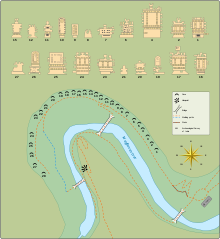
Map of Ajanta Caves
With the Ellora Caves, Ajanta is the major tourist attraction of the Marathwada region of Maharashtra. About 59 kilometres (37 miles) from Jalgaon railway station on the Delhi – Mumbai line and Howrah-Nagpur-Mumbai line of the Central Railway zone, and 104 kilometres (65 miles) from the city of Aurangabad. They are 100 kilometres (62 miles) from the Ellora Caves, which contain Hindu and Jain temples as well as Buddhist caves, the last dating from a period similar to Ajanta. The Ajanta caves are cut into the side of a cliff that is on the south side of a U-shaped gorge on the small river Waghur, and although they are now along and above a modern pathway running across the cliff they were originally reached by individual stairs or ladders from the side of the river 10–35 m (30–110 ft) below.
The area was previously heavily forested, and after the site ceased to be used the caves were covered by jungle until accidentally rediscovered in 1819 by a British officer on a hunting party. They are Buddhist monastic buildings, apparently representing a number of distinct "monasteries" or colleges. The caves are numbered 1 to 28 according to their place along the path, beginning at the entrance. Several are unfinished and some barely begun and others are small shrines, included in the traditional numbering as e.g. "9A"; "Cave 15A" was still hidden under rubble when the numbering was done. Further round the gorge are a number of waterfalls, which when the river is high are audible from outside the caves.
The caves form the largest corpus of early Indian wall-painting; other survivals from the area of modern India are very few, though they are related to 5th-century paintings at Sigiriya in Sri Lanka. The elaborate architectural carving in many caves is also very rare, and the style of the many figure sculptures is highly local, found only at a few nearby contemporary sites, although the Ajanta tradition can be related to the later Hindu Ellora Caves and other sites.
History[edit]
Like the other ancient Buddhist monasteries, Ajanta had a large emphasis on teaching, and was divided into several different caves for living, education and worship, under a central direction. Monks were probably assigned to specific caves for living. The layout reflects this organizational structure, with most of the caves only connected through the exterior. The 7th-century travelling Chinese scholar Xuanzanginforms us that Dignaga, a celebrated Buddhist philosopher and controversialist, author of well-known books on logic, lived at Ajanta in the 5th century. In its prime the settlement would have accommodated several hundred teachers and pupils. Many monks who had finished their first training may have returned to Ajanta during the monsoon season from an itinerant lifestyle.
The caves are generally agreed to have been made in two distinct periods, separated by several centuries.
Caves of the first (Satavahana) period[edit]
The earliest group of caves consists of caves 9, 10, 12, 13 and 15A. According to Walter Spink, they were made during the period 100 BCE to 100 CE, probably under the patronage of the Satavahana dynasty (230 BCE – c. 220 CE) who ruled the region. Other datings prefer the period of the mauryan dynasty (300 BCE to 100 BCE), though the grouping of the earlier caves is generally agreed. More early caves may have vanished through later excavations. Of these, caves 9 and 10 are stupa halls of chaitya-grihaform, and caves 12, 13, and 15A are vihāras (see the architecture section below for descriptions of these types). The first phase is still often called the Hinayāna phase, as it originated when, using traditional terminology, the Hinayāna or Lesser Vehicle tradition of Buddhism was dominant, when the Buddha was revered symbolically. However the use of the term Hinayana for this period of Buddhism is now deprecated by historians; equally the caves of the second period are now mostly dated too early to be properly calledMahayana, and do not yet show the full expanded cast of supernatural beings characteristic of that phase of Buddhist art. The first Satavahana period caves lacked figurative sculpture, emphasizing the stupa instead, and in the caves of the second period the overwhelming majority of images represent the Buddha alone, or narrative scenes of his lives.

The entrance to cave 19
Spink believes that some time after the Satavahana period caves were made the site was abandoned for a considerable period until the mid-5th century, probably because the region had turned mainly Hindu
Caves of the later, or Vākāṭaka, period[edit]
The second phase began in the 5th century. For a long time it was thought that the later caves were made over a long period from the 4th to the 7th centuries CE, but in recent decades a series of studies by the leading expert on the caves, Walter M. Spink, have argued that most of the work took place over the very brief period from 460 to 480 CE,during the reign of EmperorHarishena of the Vākāṭaka dynasty. This view has been criticized by some scholars, but is now broadly accepted by most authors of general books on Indian art, for example Huntington and Harle.
The second phase is still often called the Mahāyāna or Greater Vehicle phase, but scholars now tend to avoid this nomenclature because of the problems that have surfaced regarding our understanding of Mahāyāna.
Some 20 cave temples were simultaneously created, for the most part viharas with a sanctuary at the back. The most elaborate caves were produced in this period, which included some "modernization" of earlier caves. Spink claims that it is possible to establish dating for this period with a very high level of precision; a fuller account of his chronology is given below. Although debate continues, Spink's ideas are increasingly widely accepted, at least in their broad conclusions. The Archaeological Survey of India website still presents the traditional dating: "The second phase of paintings started around 5th – 6th centuries A.D. and continued for the next two centuries". Caves of the second period are 1–8, 11, 14–29, some possibly extensions of earlier caves. Caves 19, 26, and 29 are chaitya-grihas, the rest viharas.
According to Spink, the Ajanta Caves appear to have been abandoned by wealthy patrons shortly after the fall of Harishena, in about 480 CE. They were then gradually abandoned and forgotten. During the intervening centuries, the jungle grew back and the caves were hidden, unvisited and undisturbed, although the local population were aware of at least some of them.
Rediscovery

Scene from cave 1
On 28 April 1819, a British officer for the Madras Presidency, John Smith, of the 28th Cavalry, while hunting tiger, accidentally discovered the entrance to Cave No. 10 deep within the tangled undergrowth. There were local people already using the caves for prayers with a small fire, when he arrived. Exploring that first cave, long since a home to nothing more than birds and bats and a lair for other larger animals, Captain Smith vandalized the wall by scratching his name and the date, April 1819, over the body of a bodhisattva. Since he stood on a five-foot high pile of rubble collected over the years, the inscription is well above the eye-level gaze of an adult today. A paper on the caves by William Erskine was read to the Bombay Literary Society in 1822.
Within a few decades, the caves became famous for their "exotic" setting, impressive architecture, and above all their exceptional, all but unique paintings. A number of large projects to copy the paintings were made in the century after rediscovery, covered below. In 1848 the Royal Asiatic Society established the "Bombay Cave Temple Commission" to clear, tidy and record the most important rock-cut sites in the Bombay Presidency, with John Wilson as president. In 1861 this became the nucleus of the new Archaeological Survey of India.
The Ajanta site was in the territory of the princely state of the Nizam of Hyderabad rather than British India, and Ghulam Yazdani (1885-1962), who founded the archaeology department of the State of Hyderabad in 1914 and ran it for over 30 years, played a considerable role in conserving and researching the site, and publishing a series of monographs on it. Until the Nizam's government built the modern path between the caves, among other efforts to make the site easy to visit, a trip to Ajanta was a considerable adventure, and contemporary accounts dwell with relish on the dangers from falls off narrow ledges, animals and the Bhil people, who were armed with bows and arrows and had a fearsome reputation.
Today, fairly easily combined with Ellora in a single trip, the caves are the most popular tourist destination in Maharashtra, and are often crowded at holiday times, increasing the threat to the caves, especially the paintings. In 2012, the Maharashtra Tourism Development Corporation announced plans to add to the ASI visitor centre at the entrance complete replicas of caves 1, 2, 16 & 17 to reduce crowding in the originals, and enable visitors to receive a better visual idea of the paintings, which are dimly-lit and hard to read in the caves. Figures for the year to March 2010 showed a total of 390,000 visitors to the site, divided into 362,000 domestic and 27,000 foreign. The trends over the previous few years show a considerable growth in domestic visitors, but a decline in foreign ones; the year to 2010 was the first in which foreign visitors to Ellora exceeded those to Ajanta.
Paintings


Paintings of Padmapani and Vajrapani on either side of the Buddha in Cave 1
Mural paintings survive from both the earlier and later groups of caves. Several fragments of murals preserved from the earlier caves (Caves 9 and 11) are effectively unique survivals of court-led painting in India from this period, and "show that by Sātavāhana times, if not earlier, the Indian painter had mastered an easy and fluent naturalistic style, dealing with large groups of people in a manner comparable to the reliefs of the Sāñcī toraņa crossbars".
Four of the later caves have large and relatively well-preserved mural paintings which "have come to represent Indian mural painting to the non-specialist", and fall into two stylistic groups, with the most famous in Caves 16 and 17, and apparently later paintings in Caves 1 and 2. The latter group were thought to be a century or more later than the others, but the revised chronology proposed by Spink would place them much closer to the earlier group, perhaps contemporary with it in a more progressive style, or one reflecting a team from a different region.The paintings are in "dry fresco", painted on top of a dry plaster surface rather than into wet plaster.
All the paintings appear to be the work of painters at least as used to decorating palaces as temples, and show a familiarity with and interest in details of the life of a wealthy court. We know from literary sources that painting was widely practised and appreciated in the courts of the Gupta period. Unlike much Indian painting, compositions are not laid out in horizontal compartments like a frieze, but show large scenes spreading in all directions from a single figure or group at the centre. The ceilings are also painted with sophisticated and elaborate decorative motifs, many derived from sculpture. The paintings in cave 1, which according to Spink was commissioned by Harisena himself, concentrate on those Jataka tales which show previous lives of the Buddha as a king, rather than as an animal or human commoner, and so show settings from contemporary palace life.
In general the later caves seem to have been painted on finished areas as excavating work continued elsewhere in the cave, as shown in caves 2 and 16 in particular. According to Spink's account of the chronology of the caves, the abandonment of work in 478 after a brief busy period accounts for the absence of painting in places including cave 4 and the shrine of cave 17, the later being plastered in preparation for paintings that were never done.
Copies

Dancing girl in Ajanta fresco, showing deterioration between the cave now (left) and Robert Gill's copy.
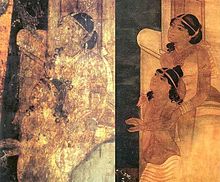
a detail: original left, copy by Lady Herringham (1915) right
The paintings have deteriorated significantly since they were rediscovered, and a number of 19th-century copies and drawings are important for a complete understanding of the works. However, the earliest projects to copy the paintings were plagued by bad fortune. In 1846, Major Robert Gill, an Army officer from Madras Presidency and a painter, was appointed by the Royal Asiatic Society through the offices of James Fergusson to make copies of the frescoes on the cave walls, which were increasingly subject to damage by visitors. Gill worked on his painting at the site from 1844 to 1863 (though he continued to be based there until his death in 1875, writing books and photographing) and made 27 copies of large sections of murals, but all but four were destroyed in a fire at the Crystal Palace in London in 1866, where they were on display.Undeterred, he returned to the site, and recommenced his labours, replicating the murals until his death in 1875.
Another attempt was made in 1872 when the Bombay Presidency commissioned John Griffiths, then principal of the Bombay School of Art, to work with his students to make new copies, again for shipping to England. They worked on this for thirteen years and some 300 canvases were produced, many of which were displayed at the Imperial Institute on Exhibition Road in London, one of the forerunners of the Victoria and Albert Museum. But in 1885 another fire destroyed over a hundred of the paintings in storage in a wing of the museum. The V&A still has 166 paintings surviving from both sets, though none have been on permanent display since 1955. The largest are some 3 × 6 metres. A conservation project was undertaken on about half of them in 2006, also involving the University of Northumbria. Griffith and his students had unfortunately painted many of the paintings with "cheap varnish" in order to make them easier to see, which has added to the deterioration of the originals, as has, according to Spink and others, recent cleaning by the ASI.
A further set of copies were made between 1909 and 1911 by Christiana Herringham (Lady Herringham) and a group of students from theCalcutta School of Art that included the future Indian Modernist painter Nandalal Bose. The copies were published in full colour as the first publication of London's fledgling India Society. More than the earlier copies, these aimed to fill in holes and damage to recreate the original condition rather than record the state of the paintings as she was seeing them. According to one writer, unlike the paintings created by her predecessors Griffiths and Gill, whose copies were influenced by British Victorian styles of painting, those of the Herringham expedition preferred an 'Indian Renascence' aesthetic of the type pioneered by Abanindranath Tagore.
================================
Early photographic surveys were made by Robert Gill, who learnt to use a camera from about 1856, and whose photos, including some using stereoscopy, were used in books by him and Fergusson (many are available online from the British Library),[43] then Victor Goloubew in 1911 and E.L. Vassey, who took the photos in the four volume study of the caves by Ghulam Yazdani (published 1930–1955).[44]
A final attempt to make copies of the murals was made by the Japanese artist Arai Kampō (荒井寛方:1878-1945) who encountered them after being invited by Rabindranath Tagore to India to teach Japanese painting techniques.[45] He worked on making copies with tracings on Japanese paper from 1916 to 1918 and his work was conserved at Tokyo Imperial University until the materials perished during the 1923 Great Kantō earthquake.

Cave 2, showing the extensive paint loss of many areas.

Cave 17, Decorative painting, and frieze with lovers

Painting from Cave 1

Section of the mural in Cave 17, the 'coming of Sinhala'. The prince (Prince Vijaya) is seen in both groups of elephants and riders.

The consecration of King Sinhala,Prince Vijaya, detail from Cave 17.

Hamsa jâtaka, cave 17. This painting probably shows one of the previous lives of the Buddha
Architecture[edit]

Plan of cave 1, a typical vihara hall for prayer and living
The majority of the caves are vihara halls for prayer and living, which are typically rectangular with small square dormitory cells cut into the walls, and by the second period a shrine or sanctuary at the rear centred on a large statue of the Buddha, also carved from the living rock. This change reflects the movement from Hinayana to Mahāyāna Buddhism. These caves are often called monasteries. The other type of main hall is the narrower and higher chaitya hall with a stupa as the focus at the far end, and a narrow aisle around the walls, behind a range of pillars placed close together. Other plainer rooms were for sleeping and other activities. Some of the caves have elaborate carved entrances, some with large windows over the door to admit light. There is often a colonnaded porch or verandah, with another space inside the doors running the width of the cave.
The central square space of the interior of the viharas is defined by square columns forming a more or less square open area. Outside this are long rectangular aisles on each side, forming a kind of cloister. Along the side and rear walls are a number of small cells entered by a narrow doorway; these are roughly square, and have small niches on their back walls. Originally they had wooden doors.[46] The centre of the rear wall has a larger shrine-room behind, containing a large Buddha statue. The viharas of the earlier period are much simpler, and lack shrines.[47] Spink in fact places the change to a design with a shrine to the middle of the second period, with many caves being adapted to add a shrine in mid-excavation, or after the original phase.[48]
The plan of Cave 1 (right) shows one of the largest viharas, but is fairly typical of the later group. Many others, such as Cave 16, lack the vestibule to the shrine, which leads straight off the main hall. Cave 6 is two viharas, one above the other, connected by internal stairs, with sanctuaries on both levels.[49]
The four completed chaitya halls are caves 9 and 10 from the early period, and caves 19 and 26 from the later period of construction. All follow the typical form found elsewhere, with high ceilings and a central "nave" leading to the stupa, which is near the back, but allows walking behind it, as walking around stupas was (and remains) a common element of Buddhist worship (pradakshina). The later two have high ribbed roofs, which reflect timber forms,[50] and the earlier two are thought to have used actual timber ribs, which have now perished.[51] The two later halls have a rather unusual arrangement (also found in Cave 10 at Ellora) where the stupa is fronted by a large relief sculpture of the Buddha, standing in Cave 19 and seated in Cave 26.[47] Cave 29 is a late and very incomplete chaitya hall.[52]

View into the sanctuary of cave 1 from the central hall. The Buddha in the shrine room is seen through the aisle and vestibule.
The form of columns in the work of the first period is very plain and un-embellished, with both chaitya halls using simple octagonal columns, which were painted with figures. In the second period columns were far more varied and inventive, often changing profile over their height, and with elaborate carved capitals, often spreading wide. Many columns are carved over all their surface, some fluted and others carved with decoration all over, as in cave 1 (illustrated left).[53]
The flood basalt rock of the cliff, part of the Deccan Traps formed by successive volcanic eruptions at the end of the Cretaceous, is layered horizontally, and somewhat variable in quality,[54] so the excavators had to amend their plans in places, and in places there have been collapses in the intervening centuries, as with the lost portico to cave 1. Excavation began by cutting a narrow tunnel at roof level, which was expanded downwards and outwards; the half-built vihara cave 24 shows the method.[55] Spink believes that for the first caves of the second period the excavators had to relearn skills and techniques that had been lost in the centuries since the first period,[56] which were then transmitted to be used at later rock-cut sites in the region, such as Ellora, and the Elephanta, Bagh, Badami and Aurangabad Caves.[57]
The caves from the first period seem to have been paid for by a number of different patrons, with several inscriptions recording the donation of particular portions of a single cave, but according to Spink the later caves were each commissioned as a complete unit by a single patron from the local rulers or their court elites. After the death of Harisena smaller donors got their chance to add small "shrinelets" between the caves or add statues to existing caves, and some two hundred of these "intrusive" additions were made in sculpture,[58] with a further number of intrusive paintings, up to three hundred in cave 10 alone.[59]
A grand gateway to the site, at the apex of the gorge's horseshoe between caves 15 and 16, was approached from the river, and is decorated with elephants on either side and anāga, or protective snake deity.[60]

Cave 9, an early chaitya hall, with murals surviving, and plain octagonal columns

Cave 10, the other chaitya hall from the first period of construction

Stupa with standing Buddha in Cave 19

Wide view of Cave 26, a late chaityahall with a stupa
Iconography of the caves[edit]

Reclining Buddha at Cave No. 26
In the pre-Christian era, the Buddha was represented symbolically, in the form of the stupa. Thus, halls were made with stupas to venerate the Buddha. In later periods the images of the Buddha started to be made in coins, relic caskets, relief or loose sculptural forms, etc. However, it took a while for the human representation of the Buddha to appear in Buddhist art. One of the earliest evidences of the Buddha's human representations are found at Buddhist archaeological sites, such as Goli, Nagarjunakonda, and Amaravati. The monasteries of those sites were built in less durable media, such as wood, brick, and stone. As far as the genre of rock-cut architecture is concerned it took many centuries for the Buddha image to be depicted. Nobody knows for sure at which rock-cut cave site the first image of the Buddha was depicted.
Current research indicates that Buddha images in a portable form, made of wood or stone, were introduced, for the first time, at Kanheri, to be followed soon at Ajanta Cave 8 (Dhavalikar, Jadhav, Spink, Singh). While the Kanheri example dates to 4th or 5th century CE, the Ajanta example has been dated to c. 462–478 CE (Spink). None of the rock-cut monasteries prior to these dates, and other than these examples, show any Buddha image although hundreds of rock-cut caves were made throughout India during the first few centuries CE. And, in those caves, it is the stupa that is the object of veneration, not the image. Images of the Buddha are not found in Buddhist sailagrhas (rock-cut complexes) until the times of the Kanheri (4th–5th century CE) and Ajanta examples (c. 462–478 CE).

Entrance to Cave 19, with later "intrusive" sculptures
The caves of the second period, now all dated to the 5th century, were typically described as "Mahayana", but do not show the features associated with later Mahayana Buddhism. Although the beginnings of Mahāyāna teachings go back to the 1st century there is little art and archaeological evidence to suggest that it became a mainstream cult for several centuries. In Mahayana it is not Gautama Buddha but the Bodhisattva who is important, including "deity" Bodhisattva like Manjushri and Tara, as well as aspects of the Buddha such asAksobhya, and Amitabha. Except for a few Bodhisattva, these are not depicted at Ajanta, where the Buddha remains the dominant figure. Even the Bodhisattva images of Ajanta are never central objects of worship, but are always shown as attendants of the Buddha in the shrine. If a Bodhisattva is shown in isolation, as in the Astabhaya scenes, these were done in the very last years of activities at Ajanta, and are mostly 'intrusive' in nature, meaning that they were not planned by the original patrons, and were added by new donors after the original patrons had suddenly abandoned the region in the wake of Emperor Harisena's death.
The contrast between iconic and aniconic representations, that is, the stupa on one hand and the image of the Buddha on the other, is now being seen as a construct of the modern scholar rather than a reality of the past. The second phase of Ajanta shows that the stupa and image coincided together. If the entire corpus of the art of Ajanta including sculpture, iconography, architecture, epigraphy, and painting are analysed afresh it will become clear that there was no duality between the symbolic and human forms of the Buddha, as far as the 5th-century phase of Ajanta is concerned. That is why most current scholars tend to avoid the terms 'Hinayana' and 'Mahayana' in the context of Ajanta. They now prefer to call the second phase by the ruling dynasty, as the Vākāţaka phase.
Caves[edit]
Cave One[edit]

Porch of cave 1
Cave 1 was built on the eastern end of the horse-shoe shaped scarp, and is now the first cave the visitor encounters. This would when first made have been a less prominent position, right at the end of the row. According to Spink, it is one of the latest caves to have been excavated, when the best sites had been taken, and was never fully inaugurated for worship by the dedication of the Buddha image in the central shrine. This is shown by the absence of sooty deposits from butter lamps on the base of the shrine image, and the lack of damage to the paintings that would have happened if the garland-hooks around the shrine had been in use for any period of time. Although there is no epigraphic evidence, Spink believes that the Vākāţaka Emperor Harishena was the benefactor of the work, and this is reflected in the emphasis on imagery of royalty in the cave, with those Jakata tales being selected that tell of those previous lives of the Buddha in which he was royal.[61]
The cliff has a more steep slope here than at other caves, so to achieve a tall grand facade it was necessary to cut far back into the slope, giving a large courtyard in front of the facade. There was originally a columned portico in front of the present facade, which can be seen "half-intact in the 1880s" in pictures of the site, but this fell down completely and the remains, despite containing fine carving, were carelessly thrown down the slope into the river, from where they have been lost, presumably carried away in monsoon torrents.[62]

Cave 1, porch: Nagendra panel flanked by yaksa panels
This cave has one of the most elaborate carved façades, with relief sculptures on entablature and ridges, and most surfaces embellished with decorative carving. There are scenes carved from the life of the Buddha as well as a number of decorative motifs. A two pillared portico, visible in the 19th-century photographs, has since perished. The cave has a front-court with cells fronted by pillared vestibules on either side. These have a high plinth level. The cave has a porch with simple cells on both ends. The absence of pillared vestibules on the ends suggest that the porch was not excavated in the latest phase of Ajanta when pillared vestibules had become a necessity and norm. Most areas of the porch were once covered with murals, of which many fragments remain, especially on the ceiling. There are three doorways: a central doorway and two side doorways. Two square windows were carved between the doorways to brighten the interiors.[63]
Each wall of the hall inside is nearly 40 feet (12 m) long and 20 feet (6.1 m) high. Twelve pillars make a square colonnade inside supporting the ceiling, and creating spacious aisles along the walls. There is a shrine carved on the rear wall to house an impressive seated image of the Buddha, his hands being in the dharmachakrapravartana mudra. There are four cells on each of the left, rear, and the right walls, though due to rock fault there are none at the ends of the rear aisle.[64] The walls are covered with paintings in a fair state of preservation, though the full scheme was never completed. The scenes depicted are mostly didactic, devotional, and ornamental, with scenes from the Jataka stories of the Buddha's former existences as a bodhisattva), the life of the Gautama Buddha, and those of his veneration. The two most famous individual painted images at Ajanta are the two over-life size figures of the protective bodhisattvas Padmapani and Vajrapani on either side of the entrance to the Buddha shrine on the wall of the rear aisle (see illustrations above).[65] According to Spink, the original dating of the paintings to about 625 arose largely or entirely because James Fergusson, a 19th-century architectural historian, had decided that a scene showing an ambassador being received, with figures in Persian dress, represented a recorded embassy to Persia (from a Hindu monarch at that) around that date.[66]
Cave Two[edit]

Detail from Cave 2
Cave 2, adjacent to Cave 1, is known for the paintings that have been preserved on its walls, ceilings, and pillars. It looks similar to Cave 1 and is in a better state of preservation.
Cave 2 has a porch quite different from Cave one. Even the façade carvings seem to be different. The cave is supported by robust pillars, ornamented with designs. The front porch consists of cells supported by pillared vestibules on both ends. The cells on the previously "wasted areas" were needed to meet the greater housing requirements in later years. Porch-end cells became a trend in all later Vakataka excavations. The simple single cells on porch-ends were converted into CPVs or were planned to provide more room, symmetry, and beauty.
The paintings on the ceilings and walls of this porch have been widely published. They depict the Jataka tales that are stories of the Buddha's life in former existences as Bodhisattva. Just as the stories illustrated in cave 1 emphasize kingship, those in cave 2 show many "noble and powerful" women in prominent roles, leading to suggestions that the patron was an unknown woman.[57] The porch's rear wall has a doorway in the center, which allows entrance to the hall. On either side of the door is a square-shaped window to brighten the interior.
The hall has four colonnades which are supporting the ceiling and surrounding a square in the center of the hall. Each arm or colonnade of the square is parallel to the respective walls of the hall, making an aisle in between. The colonnades have rock-beams above and below them. The capitals are carved and painted with various decorative themes that include ornamental, human, animal, vegetative, and semi-divine forms.
Paintings appear on almost every surface of the cave except for the floor. At various places the art work has become eroded due to decay and human interference. Therefore, many areas of the painted walls, ceilings, and pillars are fragmentary. The painted narratives of the Jataka tales are depicted only on the walls, which demanded the special attention of the devotee. They are didactic in nature, meant to inform the community about the Buddha's teachings and life through successive rebirths. Their placement on the walls required the devotee to walk through the aisles and 'read' the narratives depicted in various episodes. The narrative episodes are depicted one after another although not in a linear order. Their identification has been a core area of research since the site's rediscovery in 1819. Dieter Schlingloff's identifications have updated our knowledge on the subject.
Cave Four[edit]

The Buddha in a preaching pose flanked by bodhisattvas, Cave 4
The Archaeological Survey of India board outside the caves gives the following detail about cave 4:"This is the largest monastery planned on a grandiose scale but was never finished. An inscription on the pedestal of the buddha's image mentions that it was a gift from a person named Mathura and paleographically belongs to 6th century A.D. It consists of a verandah, a hypostylar hall, sanctum with an antechamber and a series of unfinished cells. The rear wall of the verandah contains the panel of Litany of Avalokiteśvara".
The sanctuary houses a colossal image of the Buddha in preaching pose flanked by bodhisattvas and celestial nymphs hovering above.
Caves 9–10[edit]

Entrance of cave no. 9.
Caves 9 and 10 are the two chaitya halls from the first period of construction, though both were also undergoing an uncompleted reworking at the end of the second period. Cave 10 was perhaps originally of the 1st century BCE, and cave 9 about a hundred years later. The small "shrinelets" called caves 9A to 9D and 10A also date from the second period, and were commissioned by individuals.[67]
The paintings in cave 10 include some surviving from the early period, many from an incomplete programme of modernization in the second period, and a very large number of smaller late intrusive images, nearly all Buddhas and many with donor inscriptions from individuals. These mostly avoided over-painting the "official" programme and after the best positions were used up are tucked away in less prominent positions not yet painted; the total of these (including those now lost) was probably over 300, and the hands of many different artists are visible.[68]
Cave 17[edit]
Cave 17 contains some of the best preserved and well known paintings of all the caves. It includes a panel that tells of Prince Simhala’s expedition to Sri Lanka. This includes details to a shipwreck and escaping from ogresses by a flying horse. Other notable paintings include a princess applying makeup and a prince seducing a lover with wine.[69]
Other caves[edit]

Plan of the caves
Cave 3 is merely a start of an excavation; according to Spink it was begun right at the end of the final period of work and soon abandoned.[70] Caves 5 and 6 are viharas, the latter on two floors, that were late works of which only the lower floor of cave 6 was ever finished. The upper floor of cave 6 has many private votive sculptures, and a shrine Buddha, but is otherwise unfinished.[70] Cave 7 has a grand facade with two porticos but, perhaps because of faults in the rock, which posed problems in many caves, was never taken very deep into the cliff, and consists only of the two porticos and a shrine room with antechamber, with no central hall. Some cells were fitted in.[71]
Cave 8 was long thought to date to the first period of construction, but Spink sees it as perhaps the earliest cave from the second period, its shrine an "afterthought". The statue may have been loose rather than carved from the living rock, as it has now vanished. The cave was painted, but only traces remain.[72] Cave 9 was found between Cave 15 and 16 during debris clearance. It is a small vihara with a narrow door opening into courtyard having three cells in each wall.[73]
Spink's detailed chronology[edit]
Walter M. Spink has over recent decades developed a very precise and circumstantial chronology for the second period of work on the site, which unlike earlier scholars, he places entirely in the 5th century. This is based on evidence such as the inscriptions and artistic style, combined with the many uncompleted elements of the caves. He believes the earlier group of caves, which like other scholars he dates only approximately, to the period "between 100 BCE – 100 CE", were at some later point completely abandoned and remained so "for over three centuries", as the local population had turned mainly Hindu. This changed with the accession of the Emperor Harishena of the Vakataka Dynasty, who reigned from 460 to his death in 477. Harisena extended the Central Indian Vakataka Empire to include a stretch of the east coast of India; the Gupta Empire ruled northern India at the same period, and the Pallava dynasty much of the south.[17]
According to Spink, Harisena encouraged a group of associates, including his prime minister Varahadeva and Upendragupta, the sub-king in whose territory Ajanta was, to dig out new caves, which were individually commissioned, some containing inscriptions recording the donation. This activity began in 462 but was mostly suspended in 468 because of threats from the neighbouring Asmaka kings. Work continued on only caves 1, Harisena's own commission, and 17–20, commissioned by Upendragupta. In 472 the situation was such that work was suspended completely, in a period that Spink calls "the Hiatus", which lasted until about 475, by which time the Asmakas had replaced Upendragupta as the local rulers.[74]

Panoramic view from "The Viewpoint" above the caves; the cave numbers count up from right to left
Work was then resumed, but again disrupted by Harisena's death in 477, soon after which major excavation ceased, except at cave 26, which the Asmakas were sponsoring themselves. The Asmakas launched a revolt against Harisena's son, which brought about the end of the Vakataka Dynasty. In the years 478–480 major excavation by important patrons was replaced by a rash of "intrusions" – statues added to existing caves, and small shrines dotted about where there was space between them. These were commissioned by less powerful individuals, some monks, who had not previously been able to make additions to the large excavations of the rulers and courtiers. They were added to the facades, the return sides of the entrances, and to walls inside the caves.[75] According to Spink, "After 480, not a single image was ever made again at the site", and as Hinduism again dominated the region, the site was again abandoned, this time for over a millennium.[76]
Spink does not use "circa" in his dates, but says that "one should allow a margin of error of one year or perhaps even two in all cases".[77]
Impact on modern Indian paintings[edit]
The Ajanta paintings, or more likely the general style they come from, influenced painting in Tibet[78] and Sri Lanka.[79]
The rediscovery of ancient Indian paintings at Ajanta provided Indian artists examples from ancient India to follow. Nandalal Bose experimented with techniques to follow the ancient style which allowed him to develop his unique style.[80] Abanindranath Tagore and Syed Thajudeen also used the Ajanta paintings for inspiration.
See also[edit]
Ajanta Caves
From Wikipedia, the free encyclopedia
UNESCO World Heritage SiteAjanta Caves
Name as inscribed on the World Heritage List
.jpg)
Type Cultural
Criteria i, ii, iii, vi
Reference 242
UNESCO region Asia-Pacific
Coordinates 20°33′09″N 75°42′02″ECoordinates: 20°33′09″N 75°42′02″E
Inscription history
Inscription 1983 (7th Session)

Location of Ajanta Caves in Maharashtra.
The Ajanta Caves in Aurangabad district of Maharashtra state of India are about 30 rock-cut Buddhist cave monuments which date from the 2nd century BCE to about 480 or 650 CE. The caves include paintings and sculptures described by the government Archaeological Survey of India as "the finest surviving examples of Indian art, particularly painting",which are masterpieces of Buddhist religious art, with figures of the Buddha and depictions of the Jataka tales. The caves were built in two phases starting around the 2nd century BCE, with the second group of caves built around 400–650 according to older accounts, or all in a brief period of 460 to 480 according to the recent proposals of Walter M. Spink. The site is a protected monument in the care of the Archaeological Survey of India, and since 1983, the Ajanta Caves have been a UNESCO World Heritage Site.

Panoramic view of Ajanta Caves from the nearby hill

Map of Ajanta Caves
With the Ellora Caves, Ajanta is the major tourist attraction of the Marathwada region of Maharashtra. About 59 kilometres (37 miles) from Jalgaon railway station on the Delhi – Mumbai line and Howrah-Nagpur-Mumbai line of the Central Railway zone, and 104 kilometres (65 miles) from the city of Aurangabad. They are 100 kilometres (62 miles) from the Ellora Caves, which contain Hindu and Jain temples as well as Buddhist caves, the last dating from a period similar to Ajanta. The Ajanta caves are cut into the side of a cliff that is on the south side of a U-shaped gorge on the small river Waghur, and although they are now along and above a modern pathway running across the cliff they were originally reached by individual stairs or ladders from the side of the river 10–35 m (30–110 ft) below.
The area was previously heavily forested, and after the site ceased to be used the caves were covered by jungle until accidentally rediscovered in 1819 by a British officer on a hunting party. They are Buddhist monastic buildings, apparently representing a number of distinct "monasteries" or colleges. The caves are numbered 1 to 28 according to their place along the path, beginning at the entrance. Several are unfinished and some barely begun and others are small shrines, included in the traditional numbering as e.g. "9A"; "Cave 15A" was still hidden under rubble when the numbering was done. Further round the gorge are a number of waterfalls, which when the river is high are audible from outside the caves.
The caves form the largest corpus of early Indian wall-painting; other survivals from the area of modern India are very few, though they are related to 5th-century paintings at Sigiriya in Sri Lanka. The elaborate architectural carving in many caves is also very rare, and the style of the many figure sculptures is highly local, found only at a few nearby contemporary sites, although the Ajanta tradition can be related to the later Hindu Ellora Caves and other sites.
History[edit]
Like the other ancient Buddhist monasteries, Ajanta had a large emphasis on teaching, and was divided into several different caves for living, education and worship, under a central direction. Monks were probably assigned to specific caves for living. The layout reflects this organizational structure, with most of the caves only connected through the exterior. The 7th-century travelling Chinese scholar Xuanzanginforms us that Dignaga, a celebrated Buddhist philosopher and controversialist, author of well-known books on logic, lived at Ajanta in the 5th century. In its prime the settlement would have accommodated several hundred teachers and pupils. Many monks who had finished their first training may have returned to Ajanta during the monsoon season from an itinerant lifestyle.
The caves are generally agreed to have been made in two distinct periods, separated by several centuries.
Caves of the first (Satavahana) period[edit]
The earliest group of caves consists of caves 9, 10, 12, 13 and 15A. According to Walter Spink, they were made during the period 100 BCE to 100 CE, probably under the patronage of the Satavahana dynasty (230 BCE – c. 220 CE) who ruled the region. Other datings prefer the period of the mauryan dynasty (300 BCE to 100 BCE), though the grouping of the earlier caves is generally agreed. More early caves may have vanished through later excavations. Of these, caves 9 and 10 are stupa halls of chaitya-grihaform, and caves 12, 13, and 15A are vihāras (see the architecture section below for descriptions of these types). The first phase is still often called the Hinayāna phase, as it originated when, using traditional terminology, the Hinayāna or Lesser Vehicle tradition of Buddhism was dominant, when the Buddha was revered symbolically. However the use of the term Hinayana for this period of Buddhism is now deprecated by historians; equally the caves of the second period are now mostly dated too early to be properly calledMahayana, and do not yet show the full expanded cast of supernatural beings characteristic of that phase of Buddhist art. The first Satavahana period caves lacked figurative sculpture, emphasizing the stupa instead, and in the caves of the second period the overwhelming majority of images represent the Buddha alone, or narrative scenes of his lives.

The entrance to cave 19
Spink believes that some time after the Satavahana period caves were made the site was abandoned for a considerable period until the mid-5th century, probably because the region had turned mainly Hindu
Caves of the later, or Vākāṭaka, period[edit]
The second phase began in the 5th century. For a long time it was thought that the later caves were made over a long period from the 4th to the 7th centuries CE, but in recent decades a series of studies by the leading expert on the caves, Walter M. Spink, have argued that most of the work took place over the very brief period from 460 to 480 CE,during the reign of EmperorHarishena of the Vākāṭaka dynasty. This view has been criticized by some scholars, but is now broadly accepted by most authors of general books on Indian art, for example Huntington and Harle.
The second phase is still often called the Mahāyāna or Greater Vehicle phase, but scholars now tend to avoid this nomenclature because of the problems that have surfaced regarding our understanding of Mahāyāna.
Some 20 cave temples were simultaneously created, for the most part viharas with a sanctuary at the back. The most elaborate caves were produced in this period, which included some "modernization" of earlier caves. Spink claims that it is possible to establish dating for this period with a very high level of precision; a fuller account of his chronology is given below. Although debate continues, Spink's ideas are increasingly widely accepted, at least in their broad conclusions. The Archaeological Survey of India website still presents the traditional dating: "The second phase of paintings started around 5th – 6th centuries A.D. and continued for the next two centuries". Caves of the second period are 1–8, 11, 14–29, some possibly extensions of earlier caves. Caves 19, 26, and 29 are chaitya-grihas, the rest viharas.
According to Spink, the Ajanta Caves appear to have been abandoned by wealthy patrons shortly after the fall of Harishena, in about 480 CE. They were then gradually abandoned and forgotten. During the intervening centuries, the jungle grew back and the caves were hidden, unvisited and undisturbed, although the local population were aware of at least some of them.
Rediscovery

Scene from cave 1
On 28 April 1819, a British officer for the Madras Presidency, John Smith, of the 28th Cavalry, while hunting tiger, accidentally discovered the entrance to Cave No. 10 deep within the tangled undergrowth. There were local people already using the caves for prayers with a small fire, when he arrived. Exploring that first cave, long since a home to nothing more than birds and bats and a lair for other larger animals, Captain Smith vandalized the wall by scratching his name and the date, April 1819, over the body of a bodhisattva. Since he stood on a five-foot high pile of rubble collected over the years, the inscription is well above the eye-level gaze of an adult today. A paper on the caves by William Erskine was read to the Bombay Literary Society in 1822.
Within a few decades, the caves became famous for their "exotic" setting, impressive architecture, and above all their exceptional, all but unique paintings. A number of large projects to copy the paintings were made in the century after rediscovery, covered below. In 1848 the Royal Asiatic Society established the "Bombay Cave Temple Commission" to clear, tidy and record the most important rock-cut sites in the Bombay Presidency, with John Wilson as president. In 1861 this became the nucleus of the new Archaeological Survey of India.
The Ajanta site was in the territory of the princely state of the Nizam of Hyderabad rather than British India, and Ghulam Yazdani (1885-1962), who founded the archaeology department of the State of Hyderabad in 1914 and ran it for over 30 years, played a considerable role in conserving and researching the site, and publishing a series of monographs on it. Until the Nizam's government built the modern path between the caves, among other efforts to make the site easy to visit, a trip to Ajanta was a considerable adventure, and contemporary accounts dwell with relish on the dangers from falls off narrow ledges, animals and the Bhil people, who were armed with bows and arrows and had a fearsome reputation.
Today, fairly easily combined with Ellora in a single trip, the caves are the most popular tourist destination in Maharashtra, and are often crowded at holiday times, increasing the threat to the caves, especially the paintings. In 2012, the Maharashtra Tourism Development Corporation announced plans to add to the ASI visitor centre at the entrance complete replicas of caves 1, 2, 16 & 17 to reduce crowding in the originals, and enable visitors to receive a better visual idea of the paintings, which are dimly-lit and hard to read in the caves. Figures for the year to March 2010 showed a total of 390,000 visitors to the site, divided into 362,000 domestic and 27,000 foreign. The trends over the previous few years show a considerable growth in domestic visitors, but a decline in foreign ones; the year to 2010 was the first in which foreign visitors to Ellora exceeded those to Ajanta.
Paintings


Paintings of Padmapani and Vajrapani on either side of the Buddha in Cave 1
Mural paintings survive from both the earlier and later groups of caves. Several fragments of murals preserved from the earlier caves (Caves 9 and 11) are effectively unique survivals of court-led painting in India from this period, and "show that by Sātavāhana times, if not earlier, the Indian painter had mastered an easy and fluent naturalistic style, dealing with large groups of people in a manner comparable to the reliefs of the Sāñcī toraņa crossbars".
Four of the later caves have large and relatively well-preserved mural paintings which "have come to represent Indian mural painting to the non-specialist", and fall into two stylistic groups, with the most famous in Caves 16 and 17, and apparently later paintings in Caves 1 and 2. The latter group were thought to be a century or more later than the others, but the revised chronology proposed by Spink would place them much closer to the earlier group, perhaps contemporary with it in a more progressive style, or one reflecting a team from a different region.The paintings are in "dry fresco", painted on top of a dry plaster surface rather than into wet plaster.
All the paintings appear to be the work of painters at least as used to decorating palaces as temples, and show a familiarity with and interest in details of the life of a wealthy court. We know from literary sources that painting was widely practised and appreciated in the courts of the Gupta period. Unlike much Indian painting, compositions are not laid out in horizontal compartments like a frieze, but show large scenes spreading in all directions from a single figure or group at the centre. The ceilings are also painted with sophisticated and elaborate decorative motifs, many derived from sculpture. The paintings in cave 1, which according to Spink was commissioned by Harisena himself, concentrate on those Jataka tales which show previous lives of the Buddha as a king, rather than as an animal or human commoner, and so show settings from contemporary palace life.
In general the later caves seem to have been painted on finished areas as excavating work continued elsewhere in the cave, as shown in caves 2 and 16 in particular. According to Spink's account of the chronology of the caves, the abandonment of work in 478 after a brief busy period accounts for the absence of painting in places including cave 4 and the shrine of cave 17, the later being plastered in preparation for paintings that were never done.
Copies

Dancing girl in Ajanta fresco, showing deterioration between the cave now (left) and Robert Gill's copy.

a detail: original left, copy by Lady Herringham (1915) right
The paintings have deteriorated significantly since they were rediscovered, and a number of 19th-century copies and drawings are important for a complete understanding of the works. However, the earliest projects to copy the paintings were plagued by bad fortune. In 1846, Major Robert Gill, an Army officer from Madras Presidency and a painter, was appointed by the Royal Asiatic Society through the offices of James Fergusson to make copies of the frescoes on the cave walls, which were increasingly subject to damage by visitors. Gill worked on his painting at the site from 1844 to 1863 (though he continued to be based there until his death in 1875, writing books and photographing) and made 27 copies of large sections of murals, but all but four were destroyed in a fire at the Crystal Palace in London in 1866, where they were on display.Undeterred, he returned to the site, and recommenced his labours, replicating the murals until his death in 1875.
Another attempt was made in 1872 when the Bombay Presidency commissioned John Griffiths, then principal of the Bombay School of Art, to work with his students to make new copies, again for shipping to England. They worked on this for thirteen years and some 300 canvases were produced, many of which were displayed at the Imperial Institute on Exhibition Road in London, one of the forerunners of the Victoria and Albert Museum. But in 1885 another fire destroyed over a hundred of the paintings in storage in a wing of the museum. The V&A still has 166 paintings surviving from both sets, though none have been on permanent display since 1955. The largest are some 3 × 6 metres. A conservation project was undertaken on about half of them in 2006, also involving the University of Northumbria. Griffith and his students had unfortunately painted many of the paintings with "cheap varnish" in order to make them easier to see, which has added to the deterioration of the originals, as has, according to Spink and others, recent cleaning by the ASI.
A further set of copies were made between 1909 and 1911 by Christiana Herringham (Lady Herringham) and a group of students from theCalcutta School of Art that included the future Indian Modernist painter Nandalal Bose. The copies were published in full colour as the first publication of London's fledgling India Society. More than the earlier copies, these aimed to fill in holes and damage to recreate the original condition rather than record the state of the paintings as she was seeing them. According to one writer, unlike the paintings created by her predecessors Griffiths and Gill, whose copies were influenced by British Victorian styles of painting, those of the Herringham expedition preferred an 'Indian Renascence' aesthetic of the type pioneered by Abanindranath Tagore.
================================
Early photographic surveys were made by Robert Gill, who learnt to use a camera from about 1856, and whose photos, including some using stereoscopy, were used in books by him and Fergusson (many are available online from the British Library),[43] then Victor Goloubew in 1911 and E.L. Vassey, who took the photos in the four volume study of the caves by Ghulam Yazdani (published 1930–1955).[44]
A final attempt to make copies of the murals was made by the Japanese artist Arai Kampō (荒井寛方:1878-1945) who encountered them after being invited by Rabindranath Tagore to India to teach Japanese painting techniques.[45] He worked on making copies with tracings on Japanese paper from 1916 to 1918 and his work was conserved at Tokyo Imperial University until the materials perished during the 1923 Great Kantō earthquake.
.JPG)
Cave 2, showing the extensive paint loss of many areas.

Cave 17, Decorative painting, and frieze with lovers

Painting from Cave 1
.jpg)
Section of the mural in Cave 17, the 'coming of Sinhala'. The prince (Prince Vijaya) is seen in both groups of elephants and riders.
.jpg)
The consecration of King Sinhala,Prince Vijaya, detail from Cave 17.

Hamsa jâtaka, cave 17. This painting probably shows one of the previous lives of the Buddha
Architecture[edit]

Plan of cave 1, a typical vihara hall for prayer and living
The majority of the caves are vihara halls for prayer and living, which are typically rectangular with small square dormitory cells cut into the walls, and by the second period a shrine or sanctuary at the rear centred on a large statue of the Buddha, also carved from the living rock. This change reflects the movement from Hinayana to Mahāyāna Buddhism. These caves are often called monasteries. The other type of main hall is the narrower and higher chaitya hall with a stupa as the focus at the far end, and a narrow aisle around the walls, behind a range of pillars placed close together. Other plainer rooms were for sleeping and other activities. Some of the caves have elaborate carved entrances, some with large windows over the door to admit light. There is often a colonnaded porch or verandah, with another space inside the doors running the width of the cave.
The central square space of the interior of the viharas is defined by square columns forming a more or less square open area. Outside this are long rectangular aisles on each side, forming a kind of cloister. Along the side and rear walls are a number of small cells entered by a narrow doorway; these are roughly square, and have small niches on their back walls. Originally they had wooden doors.[46] The centre of the rear wall has a larger shrine-room behind, containing a large Buddha statue. The viharas of the earlier period are much simpler, and lack shrines.[47] Spink in fact places the change to a design with a shrine to the middle of the second period, with many caves being adapted to add a shrine in mid-excavation, or after the original phase.[48]
The plan of Cave 1 (right) shows one of the largest viharas, but is fairly typical of the later group. Many others, such as Cave 16, lack the vestibule to the shrine, which leads straight off the main hall. Cave 6 is two viharas, one above the other, connected by internal stairs, with sanctuaries on both levels.[49]
The four completed chaitya halls are caves 9 and 10 from the early period, and caves 19 and 26 from the later period of construction. All follow the typical form found elsewhere, with high ceilings and a central "nave" leading to the stupa, which is near the back, but allows walking behind it, as walking around stupas was (and remains) a common element of Buddhist worship (pradakshina). The later two have high ribbed roofs, which reflect timber forms,[50] and the earlier two are thought to have used actual timber ribs, which have now perished.[51] The two later halls have a rather unusual arrangement (also found in Cave 10 at Ellora) where the stupa is fronted by a large relief sculpture of the Buddha, standing in Cave 19 and seated in Cave 26.[47] Cave 29 is a late and very incomplete chaitya hall.[52]

View into the sanctuary of cave 1 from the central hall. The Buddha in the shrine room is seen through the aisle and vestibule.
The form of columns in the work of the first period is very plain and un-embellished, with both chaitya halls using simple octagonal columns, which were painted with figures. In the second period columns were far more varied and inventive, often changing profile over their height, and with elaborate carved capitals, often spreading wide. Many columns are carved over all their surface, some fluted and others carved with decoration all over, as in cave 1 (illustrated left).[53]
The flood basalt rock of the cliff, part of the Deccan Traps formed by successive volcanic eruptions at the end of the Cretaceous, is layered horizontally, and somewhat variable in quality,[54] so the excavators had to amend their plans in places, and in places there have been collapses in the intervening centuries, as with the lost portico to cave 1. Excavation began by cutting a narrow tunnel at roof level, which was expanded downwards and outwards; the half-built vihara cave 24 shows the method.[55] Spink believes that for the first caves of the second period the excavators had to relearn skills and techniques that had been lost in the centuries since the first period,[56] which were then transmitted to be used at later rock-cut sites in the region, such as Ellora, and the Elephanta, Bagh, Badami and Aurangabad Caves.[57]
The caves from the first period seem to have been paid for by a number of different patrons, with several inscriptions recording the donation of particular portions of a single cave, but according to Spink the later caves were each commissioned as a complete unit by a single patron from the local rulers or their court elites. After the death of Harisena smaller donors got their chance to add small "shrinelets" between the caves or add statues to existing caves, and some two hundred of these "intrusive" additions were made in sculpture,[58] with a further number of intrusive paintings, up to three hundred in cave 10 alone.[59]
A grand gateway to the site, at the apex of the gorge's horseshoe between caves 15 and 16, was approached from the river, and is decorated with elephants on either side and anāga, or protective snake deity.[60]

Cave 9, an early chaitya hall, with murals surviving, and plain octagonal columns

Cave 10, the other chaitya hall from the first period of construction

Stupa with standing Buddha in Cave 19

Wide view of Cave 26, a late chaityahall with a stupa
Iconography of the caves[edit]

Reclining Buddha at Cave No. 26
In the pre-Christian era, the Buddha was represented symbolically, in the form of the stupa. Thus, halls were made with stupas to venerate the Buddha. In later periods the images of the Buddha started to be made in coins, relic caskets, relief or loose sculptural forms, etc. However, it took a while for the human representation of the Buddha to appear in Buddhist art. One of the earliest evidences of the Buddha's human representations are found at Buddhist archaeological sites, such as Goli, Nagarjunakonda, and Amaravati. The monasteries of those sites were built in less durable media, such as wood, brick, and stone. As far as the genre of rock-cut architecture is concerned it took many centuries for the Buddha image to be depicted. Nobody knows for sure at which rock-cut cave site the first image of the Buddha was depicted.
Current research indicates that Buddha images in a portable form, made of wood or stone, were introduced, for the first time, at Kanheri, to be followed soon at Ajanta Cave 8 (Dhavalikar, Jadhav, Spink, Singh). While the Kanheri example dates to 4th or 5th century CE, the Ajanta example has been dated to c. 462–478 CE (Spink). None of the rock-cut monasteries prior to these dates, and other than these examples, show any Buddha image although hundreds of rock-cut caves were made throughout India during the first few centuries CE. And, in those caves, it is the stupa that is the object of veneration, not the image. Images of the Buddha are not found in Buddhist sailagrhas (rock-cut complexes) until the times of the Kanheri (4th–5th century CE) and Ajanta examples (c. 462–478 CE).

Entrance to Cave 19, with later "intrusive" sculptures
The caves of the second period, now all dated to the 5th century, were typically described as "Mahayana", but do not show the features associated with later Mahayana Buddhism. Although the beginnings of Mahāyāna teachings go back to the 1st century there is little art and archaeological evidence to suggest that it became a mainstream cult for several centuries. In Mahayana it is not Gautama Buddha but the Bodhisattva who is important, including "deity" Bodhisattva like Manjushri and Tara, as well as aspects of the Buddha such asAksobhya, and Amitabha. Except for a few Bodhisattva, these are not depicted at Ajanta, where the Buddha remains the dominant figure. Even the Bodhisattva images of Ajanta are never central objects of worship, but are always shown as attendants of the Buddha in the shrine. If a Bodhisattva is shown in isolation, as in the Astabhaya scenes, these were done in the very last years of activities at Ajanta, and are mostly 'intrusive' in nature, meaning that they were not planned by the original patrons, and were added by new donors after the original patrons had suddenly abandoned the region in the wake of Emperor Harisena's death.
The contrast between iconic and aniconic representations, that is, the stupa on one hand and the image of the Buddha on the other, is now being seen as a construct of the modern scholar rather than a reality of the past. The second phase of Ajanta shows that the stupa and image coincided together. If the entire corpus of the art of Ajanta including sculpture, iconography, architecture, epigraphy, and painting are analysed afresh it will become clear that there was no duality between the symbolic and human forms of the Buddha, as far as the 5th-century phase of Ajanta is concerned. That is why most current scholars tend to avoid the terms 'Hinayana' and 'Mahayana' in the context of Ajanta. They now prefer to call the second phase by the ruling dynasty, as the Vākāţaka phase.
Caves[edit]
Cave One[edit]

Porch of cave 1
Cave 1 was built on the eastern end of the horse-shoe shaped scarp, and is now the first cave the visitor encounters. This would when first made have been a less prominent position, right at the end of the row. According to Spink, it is one of the latest caves to have been excavated, when the best sites had been taken, and was never fully inaugurated for worship by the dedication of the Buddha image in the central shrine. This is shown by the absence of sooty deposits from butter lamps on the base of the shrine image, and the lack of damage to the paintings that would have happened if the garland-hooks around the shrine had been in use for any period of time. Although there is no epigraphic evidence, Spink believes that the Vākāţaka Emperor Harishena was the benefactor of the work, and this is reflected in the emphasis on imagery of royalty in the cave, with those Jakata tales being selected that tell of those previous lives of the Buddha in which he was royal.[61]
The cliff has a more steep slope here than at other caves, so to achieve a tall grand facade it was necessary to cut far back into the slope, giving a large courtyard in front of the facade. There was originally a columned portico in front of the present facade, which can be seen "half-intact in the 1880s" in pictures of the site, but this fell down completely and the remains, despite containing fine carving, were carelessly thrown down the slope into the river, from where they have been lost, presumably carried away in monsoon torrents.[62]

Cave 1, porch: Nagendra panel flanked by yaksa panels
This cave has one of the most elaborate carved façades, with relief sculptures on entablature and ridges, and most surfaces embellished with decorative carving. There are scenes carved from the life of the Buddha as well as a number of decorative motifs. A two pillared portico, visible in the 19th-century photographs, has since perished. The cave has a front-court with cells fronted by pillared vestibules on either side. These have a high plinth level. The cave has a porch with simple cells on both ends. The absence of pillared vestibules on the ends suggest that the porch was not excavated in the latest phase of Ajanta when pillared vestibules had become a necessity and norm. Most areas of the porch were once covered with murals, of which many fragments remain, especially on the ceiling. There are three doorways: a central doorway and two side doorways. Two square windows were carved between the doorways to brighten the interiors.[63]
Each wall of the hall inside is nearly 40 feet (12 m) long and 20 feet (6.1 m) high. Twelve pillars make a square colonnade inside supporting the ceiling, and creating spacious aisles along the walls. There is a shrine carved on the rear wall to house an impressive seated image of the Buddha, his hands being in the dharmachakrapravartana mudra. There are four cells on each of the left, rear, and the right walls, though due to rock fault there are none at the ends of the rear aisle.[64] The walls are covered with paintings in a fair state of preservation, though the full scheme was never completed. The scenes depicted are mostly didactic, devotional, and ornamental, with scenes from the Jataka stories of the Buddha's former existences as a bodhisattva), the life of the Gautama Buddha, and those of his veneration. The two most famous individual painted images at Ajanta are the two over-life size figures of the protective bodhisattvas Padmapani and Vajrapani on either side of the entrance to the Buddha shrine on the wall of the rear aisle (see illustrations above).[65] According to Spink, the original dating of the paintings to about 625 arose largely or entirely because James Fergusson, a 19th-century architectural historian, had decided that a scene showing an ambassador being received, with figures in Persian dress, represented a recorded embassy to Persia (from a Hindu monarch at that) around that date.[66]
Cave Two[edit]

Detail from Cave 2
Cave 2, adjacent to Cave 1, is known for the paintings that have been preserved on its walls, ceilings, and pillars. It looks similar to Cave 1 and is in a better state of preservation.
Cave 2 has a porch quite different from Cave one. Even the façade carvings seem to be different. The cave is supported by robust pillars, ornamented with designs. The front porch consists of cells supported by pillared vestibules on both ends. The cells on the previously "wasted areas" were needed to meet the greater housing requirements in later years. Porch-end cells became a trend in all later Vakataka excavations. The simple single cells on porch-ends were converted into CPVs or were planned to provide more room, symmetry, and beauty.
The paintings on the ceilings and walls of this porch have been widely published. They depict the Jataka tales that are stories of the Buddha's life in former existences as Bodhisattva. Just as the stories illustrated in cave 1 emphasize kingship, those in cave 2 show many "noble and powerful" women in prominent roles, leading to suggestions that the patron was an unknown woman.[57] The porch's rear wall has a doorway in the center, which allows entrance to the hall. On either side of the door is a square-shaped window to brighten the interior.
The hall has four colonnades which are supporting the ceiling and surrounding a square in the center of the hall. Each arm or colonnade of the square is parallel to the respective walls of the hall, making an aisle in between. The colonnades have rock-beams above and below them. The capitals are carved and painted with various decorative themes that include ornamental, human, animal, vegetative, and semi-divine forms.
Paintings appear on almost every surface of the cave except for the floor. At various places the art work has become eroded due to decay and human interference. Therefore, many areas of the painted walls, ceilings, and pillars are fragmentary. The painted narratives of the Jataka tales are depicted only on the walls, which demanded the special attention of the devotee. They are didactic in nature, meant to inform the community about the Buddha's teachings and life through successive rebirths. Their placement on the walls required the devotee to walk through the aisles and 'read' the narratives depicted in various episodes. The narrative episodes are depicted one after another although not in a linear order. Their identification has been a core area of research since the site's rediscovery in 1819. Dieter Schlingloff's identifications have updated our knowledge on the subject.
Cave Four[edit]

The Buddha in a preaching pose flanked by bodhisattvas, Cave 4
The Archaeological Survey of India board outside the caves gives the following detail about cave 4:"This is the largest monastery planned on a grandiose scale but was never finished. An inscription on the pedestal of the buddha's image mentions that it was a gift from a person named Mathura and paleographically belongs to 6th century A.D. It consists of a verandah, a hypostylar hall, sanctum with an antechamber and a series of unfinished cells. The rear wall of the verandah contains the panel of Litany of Avalokiteśvara".
The sanctuary houses a colossal image of the Buddha in preaching pose flanked by bodhisattvas and celestial nymphs hovering above.
Caves 9–10[edit]

Entrance of cave no. 9.
Caves 9 and 10 are the two chaitya halls from the first period of construction, though both were also undergoing an uncompleted reworking at the end of the second period. Cave 10 was perhaps originally of the 1st century BCE, and cave 9 about a hundred years later. The small "shrinelets" called caves 9A to 9D and 10A also date from the second period, and were commissioned by individuals.[67]
The paintings in cave 10 include some surviving from the early period, many from an incomplete programme of modernization in the second period, and a very large number of smaller late intrusive images, nearly all Buddhas and many with donor inscriptions from individuals. These mostly avoided over-painting the "official" programme and after the best positions were used up are tucked away in less prominent positions not yet painted; the total of these (including those now lost) was probably over 300, and the hands of many different artists are visible.[68]
Cave 17[edit]
Cave 17 contains some of the best preserved and well known paintings of all the caves. It includes a panel that tells of Prince Simhala’s expedition to Sri Lanka. This includes details to a shipwreck and escaping from ogresses by a flying horse. Other notable paintings include a princess applying makeup and a prince seducing a lover with wine.[69]
Other caves[edit]

Plan of the caves
Cave 3 is merely a start of an excavation; according to Spink it was begun right at the end of the final period of work and soon abandoned.[70] Caves 5 and 6 are viharas, the latter on two floors, that were late works of which only the lower floor of cave 6 was ever finished. The upper floor of cave 6 has many private votive sculptures, and a shrine Buddha, but is otherwise unfinished.[70] Cave 7 has a grand facade with two porticos but, perhaps because of faults in the rock, which posed problems in many caves, was never taken very deep into the cliff, and consists only of the two porticos and a shrine room with antechamber, with no central hall. Some cells were fitted in.[71]
Cave 8 was long thought to date to the first period of construction, but Spink sees it as perhaps the earliest cave from the second period, its shrine an "afterthought". The statue may have been loose rather than carved from the living rock, as it has now vanished. The cave was painted, but only traces remain.[72] Cave 9 was found between Cave 15 and 16 during debris clearance. It is a small vihara with a narrow door opening into courtyard having three cells in each wall.[73]
Spink's detailed chronology[edit]
Walter M. Spink has over recent decades developed a very precise and circumstantial chronology for the second period of work on the site, which unlike earlier scholars, he places entirely in the 5th century. This is based on evidence such as the inscriptions and artistic style, combined with the many uncompleted elements of the caves. He believes the earlier group of caves, which like other scholars he dates only approximately, to the period "between 100 BCE – 100 CE", were at some later point completely abandoned and remained so "for over three centuries", as the local population had turned mainly Hindu. This changed with the accession of the Emperor Harishena of the Vakataka Dynasty, who reigned from 460 to his death in 477. Harisena extended the Central Indian Vakataka Empire to include a stretch of the east coast of India; the Gupta Empire ruled northern India at the same period, and the Pallava dynasty much of the south.[17]
According to Spink, Harisena encouraged a group of associates, including his prime minister Varahadeva and Upendragupta, the sub-king in whose territory Ajanta was, to dig out new caves, which were individually commissioned, some containing inscriptions recording the donation. This activity began in 462 but was mostly suspended in 468 because of threats from the neighbouring Asmaka kings. Work continued on only caves 1, Harisena's own commission, and 17–20, commissioned by Upendragupta. In 472 the situation was such that work was suspended completely, in a period that Spink calls "the Hiatus", which lasted until about 475, by which time the Asmakas had replaced Upendragupta as the local rulers.[74]

Panoramic view from "The Viewpoint" above the caves; the cave numbers count up from right to left
Work was then resumed, but again disrupted by Harisena's death in 477, soon after which major excavation ceased, except at cave 26, which the Asmakas were sponsoring themselves. The Asmakas launched a revolt against Harisena's son, which brought about the end of the Vakataka Dynasty. In the years 478–480 major excavation by important patrons was replaced by a rash of "intrusions" – statues added to existing caves, and small shrines dotted about where there was space between them. These were commissioned by less powerful individuals, some monks, who had not previously been able to make additions to the large excavations of the rulers and courtiers. They were added to the facades, the return sides of the entrances, and to walls inside the caves.[75] According to Spink, "After 480, not a single image was ever made again at the site", and as Hinduism again dominated the region, the site was again abandoned, this time for over a millennium.[76]
Spink does not use "circa" in his dates, but says that "one should allow a margin of error of one year or perhaps even two in all cases".[77]
Impact on modern Indian paintings[edit]
The Ajanta paintings, or more likely the general style they come from, influenced painting in Tibet[78] and Sri Lanka.[79]
The rediscovery of ancient Indian paintings at Ajanta provided Indian artists examples from ancient India to follow. Nandalal Bose experimented with techniques to follow the ancient style which allowed him to develop his unique style.[80] Abanindranath Tagore and Syed Thajudeen also used the Ajanta paintings for inspiration.
See also[edit]
=========================================================
Ellora Caves
From Wikipedia, the free encyclopedia
UNESCO World Heritage SiteEllora caves
Name as inscribed on the World Heritage List

Kailasanatha Temple, (Cave 16)
view from the top of the rock
Type Cultural
Criteria (i) (iii) (vi)
Reference 243
UNESCO region South Asia
Inscription history
Inscription 1983 (Unknown Session)

Location of Ellora Caves in India Maharashtra.
Ellora (\e-ˈlȯr-ə\, Vērūḷ) is an archaeological site 29 km (18 mi) north-west of the city of Aurangabad in the Indian state ofMaharashtra, built by the Rashtrakuta dynasty (Brahmanical & Buddhist group of caves) and Yadav (Jain group of caves). Well known for its monumental caves, Ellora is an UNESCO World Heritage Site and forms one of major tourist attraction in Marathwada region of Maharashtra[1] Ellora represents the epitome of Indian rock-cut architecture.[2] The 34 "caves" are actually structures excavated out of the vertical face of the Charanandri hills. Hindu, Buddhist and Jain rock-cut temples and viharas and mathas were built between the 5th century and 10th century. The 17 Hindu (caves 13–29), 12 Buddhist (caves 1–12) and 5 Jain (caves 30–34) caves, built in proximity, demonstrate the religious harmony prevalent during this period of Indian history.[3] It is a protected monument under the Archaeological Survey of India.[4]
Contents [hide]
1Etymology
2History
3The Hindu caves
3.1The Kailasanatha temple
3.2The Dashavatara
3.3Other Hindu caves
4The Jain caves
4.1The Indra Sabha
4.2Other Jain caves
5The Buddhist caves
5.1Cave 10
5.2The Vishwakarma
6Geology of Ellora
7Inscriptions at Ellora
8See also
9References
10Further reading
11External links
Etymology[edit]
Ellora, also called Verul or Elura, is the cave form of the ancient name Elapura.[5]
History[edit]
Ellora is known for Hindu, Buddhist and Jain cave temples built during (6th and 9th centuries) the rule of the Kalachuri, Chalukya and Rashtrakuta dynasties. The Jagannatha Sabha a group of five Jain cave temples of 9th century built by Rashtrakuta.[6] Verul Ellora is around 28 km from Aurangabad, 450 km from Nagpur, 400 km from Mumbai, 150 km from Jalgaon & 200 km from Buldhana.
The Hindu caves[edit]
The Hindu caves were constructed between the middle of sixth century to the end of the eighth century. The early caves (caves 17–29) were constructed during the Kalachuriperiod. The work first commenced in Caves 28, 27 and 19. These were followed by two most impressive caves constructed in the early phase - Caves 29 and 21. Along with these two, work was underway at Caves 20 and 26, and slightly later at Caves 17, 19 and 28.[7] The caves 14, 15 and 16 were constructed during the Rashtrakuta period. The work began in Caves 14 and 15 and culminated in Cave 16.[7] All these structures represent a different style of creative vision and execution skills. Some were of such complexity that they required several generations of planning and co-ordination to complete.
The Kailasanatha temple[edit]
Main article: Kailasa temple, Ellora
Ellora Caves

A painted panel showing the dancing Shiva (Nataraja) from the Kailasa temple at Ellora (Cave 19). One can still see a lot of the paint that once covered the entire temple.

Wall carvings – A scene depicting the wedding ofShiva (four armed figure, right) and Parvati (two armed, left).
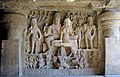
Shiva-Parvati seated on mount Kailash, while Ravana tries to lift it.

Another view of the temple's exterior.
Cave 16, also known as the Kailasa temple, is considered one of the most remarkable cave temples in India because of its size, architecture and sculptural treatment.[8] It is dedicated to Shiva, and also contains smaller, detached shrines dedicated to Ganga, Yamuna and Saraswati.[8] The structure looks like a freestanding, multi-storeyed temple complex, but it was carved out of one single rock, and covers an area double the size of Parthenon in Athens.[9]
The construction of the temple is often attributed to the Rashtrakuta king Krishna I (r. 756-773 CE), based on certain epigraphs.[10] The temple shows traces of Pallava style.[11] The dimensions of the courtyard are 82 m x 46 m at the base. The entrance features a low gopuram. The central shrine housing the lingam features a flat-roofed mandapa supported by 16 pillars, and a Dravidian shikhara. An image of Shiva's mount Nandi (the sacred bull) stands on a porch in front of the temple. The temple complex features several sculptures, including that of Ravana attempting to lift Mount Kailasa.[8]
The Dashavatara[edit]
The Dashavatara (Cave 15) was begun as a Buddhist monastery. It has an open court with a free-standing monolithicmandapa at the middle and a two-storeyed excavated temple at the rear. The layout of the temple is closely related to caves 11 and 12. Large sculptural panels between the wall columns on the upper floor illustrate a wide range of themes, which include the ten avatars of Vishnu. An inscription of grant of Dantidurga is found on the back wall of the frontmandapa. According to Coomaraswamy, the finest relief of this cave is the one depicting the death of Hiranyakashipu, where Vishnu in man-lion (Narasimha) form, emerges from a pillar to lay a fatal hand upon the shoulder of Hiranyakashipu.[12]
Other Hindu caves[edit]

Cave 21
Other notable Hindu caves are the Rameshvara (Cave 21), which has figurines of river goddesses Ganga and Yamuna at the entrance and the Dhumar Lena (Cave 29) whose design is similar to the cave temple on Elephanta Island near Mumbai. Two other caves, the Ravan ki Khai (Cave 14) and the Nilkantha (Cave 22) also have several sculptures. The rest of the Hindu caves, which include the Kumbharvada (Cave 25) and the Gopilena (Cave 27) have no significant sculptures.
The Jain caves[edit]

Ellora caves. Cave 34. The yakshini Ambikasculpture
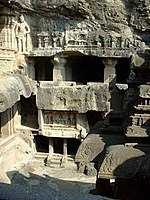
A Jain cave in Ellora
The five Jain caves at Ellora belong to the ninth and tenth centuries. They all belong to the Digambara sect.[13] Jain caves reveal specific dimensions of Jain philosophy and tradition. They reflect a strict sense of asceticism – they are not relatively large as compared to others, but they present exceptionally detailed art works. The most remarkable Jain shrines are the Chhota Kailash (cave 30), the Indra Sabha (cave 32) and the Jagannath Sabha (cave 33). Cave 31 is an unfinished four-pillared hall and a shrine.[14] Cave 34 is a small cave, which can be approached through an opening on the left side of Cave 33.[15] Amongst other devotional carvings, a place called Samavasarana can be found in Elora caves. Samavasarana is of special interest to Jains, as it is a hall where the tirthankarapreaches after attaining omniscience.[16]
The Indra Sabha[edit]
The Indra Sabha (Cave 32) is a two storeyed cave with one more monolithic shrine in its court. It has a very fine carving of the lotus flower on the ceiling. It got the appellation "Indra Sabha" probably it is significantly ornate and also because of the sculpture of the yaksha (dedicated attendant deity) Matanga on an elephant, which was wrongly identified as that of Indra. On the upper level of the double-storied shrine excavated at the rear of the court, an U image of Ambika, the yakshini of Neminath, is found seated on her lion under a mango tree, laden with fruits.
Other Jain caves[edit]
All other Jain caves are also characterized by intricate detailing. Many of the structures had rich paintings in the ceilings – fragments of which are still visible.
The Buddhist caves[edit]
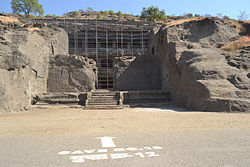
Cave no. 12

Painting of the mountain of Ellora, byThomas Daniell (1803).

Ellora Caves, general map.

Plan of Cave No. 5 (Mahawara Cave)
These caves were built during the 5th-7th century. It was initially thought that the Buddhist caves were one of the earliest structures, created between the fifth and eighth centuries, with caves 1-5 in the first phase (400-600) and 6-12 in the later phase (mid 7th-mid 8th), but now it is clear to the modern scholars that some of the Hindu caves (27,29,21,28,19,26,20,17 and 14) precede these caves.[citation needed] The earliest Buddhist cave is Cave 6, followed by 5,2,3,5 (right wing), 4,7,8,10 and 9. Caves 11 and 12 were the last. All the Buddhist caves were constructed between 630-700.[17]
These structures consist mostly of viharas or monasteries: large, multi-storeyed buildings carved into the mountain face, including living quarters, sleeping quarters, kitchens, and other rooms. Some of these monastery caves have shrines including carvings of Gautama Buddha, bodhisattvas and saints. In many of these caves, sculptors have endeavoured to give the stone the look of wood.[18]
Most famous of the Buddhist caves is cave 10,(refer map) a chaitya hall (chandrashala) or 'Vishvakarma cave', popularly known as the 'Carpenter's Cave'. Beyond its multi-storeyed entry is a cathedral-like stupa hall also known as chaitya, whose ceiling has been carved to give the impression of wooden beams. At the heart of this cave is a 15-foot statue of Buddha seated in a preaching pose. Amongst other Buddhist caves, all of the first nine (caves 1–9) are monasteries. The last two caves, Do Tal (cave 11) and Tin Tal (cave 12) have three stories.
Cave 10[edit]
Cave 10 is a vihara with eight cells, four in the back wall and four in the right wall. It had a portico in the front with a cell.[17] Possibly served as a granary for other viharas.
The Vishwakarma[edit]

The Buddhist "Carpenter's" cave (Cave 10)
The Vishwakarma (Cave 10) is the only chaitya griha amongst the Buddhist group of caves. It is locally known as Vishwakarma"celestial architect" or Sutar ka jhopda "carpenter's hut". It follows the pattern of construction of Caves 19 and 26 of Ajanta. On stylistic grounds, the date of construction of this cave is assigned to 700 A.D. The chaitya once had a high screen wall, which is ruined at present. At the front is a rock-cut court, which is entered through a flight of steps. Upstairs, on either side are pillared porticos with chambers in their back walls. These were probably intended to have subsidiary shrines but not completed. The pillaredverandah of the chaitya has a small shrine at either end and a single cell in the far end of the back wall. The corridor columns have massive squarish shafts and ghata-pallava (vase and foliage) capitals. The main hall is apsidal on plan and is divided into a central nave and side aisles by 28 octagonal columns with plain bracket capitals. In the apsidal end of the chaitya hall is a stupa on the face of which a colossal 3.30 m high seated Buddha in vyakhyana mudra (teaching posture) is carved. A large Bodhi tree is carved at the back. The hall has a vaulted roof in which ribs (known as triforium) have been carved in the rock imitating the wooden ones.[19] The friezes above the pillars are Naga queens, symbolic of the monsoon, as well as dwarfs as entertainers, dancing and playing musical instruments.[20]
Geology of Ellora[edit]
Ellora occupies a relatively flat region of the Western Ghats. Ancient volcanic activity in this area created many layered basaltformations, known as Deccan Traps. During the Cretaceous, one such volcanic hill formed on the southwest-facing side of Ellora. Its vertical face made access to many layers of rock formations easier, enabling architects to pick basalt with finer grains for more detailed sculpting.[21]
Inscriptions at Ellora[edit]
Several inscriptions at Ellora[22] range from 6th century to 15th century. The best known of them is an inscription of Rashtrakuta Dantidurga (c. 753-57 A.D.) on the back wall of the front mandapa of Cave 15, which gives an account of his conquests. Inscriptions on the Kailash temple itself range from 9th to 15th century. Jain cave Jagannatha Sabha has 3 inscriptions that give the names of monks and donors. A Parshvanth temple on the hill [23] has an 11th-century inscription that gives the name of the donor from Vardhanapura.
The Great Kailasa (Cave 16) is attributed to Krishna I (c. 757-83 A.D.), the successor and uncle of Dantidurga. A copper plate grant by Karka II (c. 812-13 A.D.) narrates that a great edifice was built on a hill by Krishnaraja at Elapura (Ellora).
The Ellora caves, unlike Ajanta, were never lost. There have been several written records that indicate that these caves were visited regularly. The earliest is that of the Arab geographer Al-Mas‘udiof the 10th century A.D. In 1352 A.D. Sultan Hasan Gangu Bahmani, who camped at the site and visited the caves. The others are by Firishta, Thevenot (1633–67), Niccolao Manucci (1653-1708), Charles Warre Malet (1794), and Seely (1824)[24]
See also[edit]
Ellora Caves
From Wikipedia, the free encyclopedia
UNESCO World Heritage SiteEllora caves
Name as inscribed on the World Heritage List

Kailasanatha Temple, (Cave 16)
view from the top of the rock
Type Cultural
Criteria (i) (iii) (vi)
Reference 243
UNESCO region South Asia
Inscription history
Inscription 1983 (Unknown Session)
Location of Ellora Caves in India Maharashtra.
Ellora (\e-ˈlȯr-ə\, Vērūḷ) is an archaeological site 29 km (18 mi) north-west of the city of Aurangabad in the Indian state ofMaharashtra, built by the Rashtrakuta dynasty (Brahmanical & Buddhist group of caves) and Yadav (Jain group of caves). Well known for its monumental caves, Ellora is an UNESCO World Heritage Site and forms one of major tourist attraction in Marathwada region of Maharashtra[1] Ellora represents the epitome of Indian rock-cut architecture.[2] The 34 "caves" are actually structures excavated out of the vertical face of the Charanandri hills. Hindu, Buddhist and Jain rock-cut temples and viharas and mathas were built between the 5th century and 10th century. The 17 Hindu (caves 13–29), 12 Buddhist (caves 1–12) and 5 Jain (caves 30–34) caves, built in proximity, demonstrate the religious harmony prevalent during this period of Indian history.[3] It is a protected monument under the Archaeological Survey of India.[4]
Contents [hide]
1Etymology
2History
3The Hindu caves
3.1The Kailasanatha temple
3.2The Dashavatara
3.3Other Hindu caves
4The Jain caves
4.1The Indra Sabha
4.2Other Jain caves
5The Buddhist caves
5.1Cave 10
5.2The Vishwakarma
6Geology of Ellora
7Inscriptions at Ellora
8See also
9References
10Further reading
11External links
Etymology[edit]
Ellora, also called Verul or Elura, is the cave form of the ancient name Elapura.[5]
History[edit]
Ellora is known for Hindu, Buddhist and Jain cave temples built during (6th and 9th centuries) the rule of the Kalachuri, Chalukya and Rashtrakuta dynasties. The Jagannatha Sabha a group of five Jain cave temples of 9th century built by Rashtrakuta.[6] Verul Ellora is around 28 km from Aurangabad, 450 km from Nagpur, 400 km from Mumbai, 150 km from Jalgaon & 200 km from Buldhana.
The Hindu caves[edit]
The Hindu caves were constructed between the middle of sixth century to the end of the eighth century. The early caves (caves 17–29) were constructed during the Kalachuriperiod. The work first commenced in Caves 28, 27 and 19. These were followed by two most impressive caves constructed in the early phase - Caves 29 and 21. Along with these two, work was underway at Caves 20 and 26, and slightly later at Caves 17, 19 and 28.[7] The caves 14, 15 and 16 were constructed during the Rashtrakuta period. The work began in Caves 14 and 15 and culminated in Cave 16.[7] All these structures represent a different style of creative vision and execution skills. Some were of such complexity that they required several generations of planning and co-ordination to complete.
The Kailasanatha temple[edit]
Main article: Kailasa temple, Ellora
Ellora Caves

A painted panel showing the dancing Shiva (Nataraja) from the Kailasa temple at Ellora (Cave 19). One can still see a lot of the paint that once covered the entire temple.

Wall carvings – A scene depicting the wedding ofShiva (four armed figure, right) and Parvati (two armed, left).

Shiva-Parvati seated on mount Kailash, while Ravana tries to lift it.

Another view of the temple's exterior.
Cave 16, also known as the Kailasa temple, is considered one of the most remarkable cave temples in India because of its size, architecture and sculptural treatment.[8] It is dedicated to Shiva, and also contains smaller, detached shrines dedicated to Ganga, Yamuna and Saraswati.[8] The structure looks like a freestanding, multi-storeyed temple complex, but it was carved out of one single rock, and covers an area double the size of Parthenon in Athens.[9]
The construction of the temple is often attributed to the Rashtrakuta king Krishna I (r. 756-773 CE), based on certain epigraphs.[10] The temple shows traces of Pallava style.[11] The dimensions of the courtyard are 82 m x 46 m at the base. The entrance features a low gopuram. The central shrine housing the lingam features a flat-roofed mandapa supported by 16 pillars, and a Dravidian shikhara. An image of Shiva's mount Nandi (the sacred bull) stands on a porch in front of the temple. The temple complex features several sculptures, including that of Ravana attempting to lift Mount Kailasa.[8]
The Dashavatara[edit]
The Dashavatara (Cave 15) was begun as a Buddhist monastery. It has an open court with a free-standing monolithicmandapa at the middle and a two-storeyed excavated temple at the rear. The layout of the temple is closely related to caves 11 and 12. Large sculptural panels between the wall columns on the upper floor illustrate a wide range of themes, which include the ten avatars of Vishnu. An inscription of grant of Dantidurga is found on the back wall of the frontmandapa. According to Coomaraswamy, the finest relief of this cave is the one depicting the death of Hiranyakashipu, where Vishnu in man-lion (Narasimha) form, emerges from a pillar to lay a fatal hand upon the shoulder of Hiranyakashipu.[12]
Other Hindu caves[edit]

Cave 21
Other notable Hindu caves are the Rameshvara (Cave 21), which has figurines of river goddesses Ganga and Yamuna at the entrance and the Dhumar Lena (Cave 29) whose design is similar to the cave temple on Elephanta Island near Mumbai. Two other caves, the Ravan ki Khai (Cave 14) and the Nilkantha (Cave 22) also have several sculptures. The rest of the Hindu caves, which include the Kumbharvada (Cave 25) and the Gopilena (Cave 27) have no significant sculptures.
The Jain caves[edit]

Ellora caves. Cave 34. The yakshini Ambikasculpture

A Jain cave in Ellora
The five Jain caves at Ellora belong to the ninth and tenth centuries. They all belong to the Digambara sect.[13] Jain caves reveal specific dimensions of Jain philosophy and tradition. They reflect a strict sense of asceticism – they are not relatively large as compared to others, but they present exceptionally detailed art works. The most remarkable Jain shrines are the Chhota Kailash (cave 30), the Indra Sabha (cave 32) and the Jagannath Sabha (cave 33). Cave 31 is an unfinished four-pillared hall and a shrine.[14] Cave 34 is a small cave, which can be approached through an opening on the left side of Cave 33.[15] Amongst other devotional carvings, a place called Samavasarana can be found in Elora caves. Samavasarana is of special interest to Jains, as it is a hall where the tirthankarapreaches after attaining omniscience.[16]
The Indra Sabha[edit]
The Indra Sabha (Cave 32) is a two storeyed cave with one more monolithic shrine in its court. It has a very fine carving of the lotus flower on the ceiling. It got the appellation "Indra Sabha" probably it is significantly ornate and also because of the sculpture of the yaksha (dedicated attendant deity) Matanga on an elephant, which was wrongly identified as that of Indra. On the upper level of the double-storied shrine excavated at the rear of the court, an U image of Ambika, the yakshini of Neminath, is found seated on her lion under a mango tree, laden with fruits.
Other Jain caves[edit]
All other Jain caves are also characterized by intricate detailing. Many of the structures had rich paintings in the ceilings – fragments of which are still visible.
The Buddhist caves[edit]

Cave no. 12

Painting of the mountain of Ellora, byThomas Daniell (1803).

Ellora Caves, general map.

Plan of Cave No. 5 (Mahawara Cave)
These caves were built during the 5th-7th century. It was initially thought that the Buddhist caves were one of the earliest structures, created between the fifth and eighth centuries, with caves 1-5 in the first phase (400-600) and 6-12 in the later phase (mid 7th-mid 8th), but now it is clear to the modern scholars that some of the Hindu caves (27,29,21,28,19,26,20,17 and 14) precede these caves.[citation needed] The earliest Buddhist cave is Cave 6, followed by 5,2,3,5 (right wing), 4,7,8,10 and 9. Caves 11 and 12 were the last. All the Buddhist caves were constructed between 630-700.[17]
These structures consist mostly of viharas or monasteries: large, multi-storeyed buildings carved into the mountain face, including living quarters, sleeping quarters, kitchens, and other rooms. Some of these monastery caves have shrines including carvings of Gautama Buddha, bodhisattvas and saints. In many of these caves, sculptors have endeavoured to give the stone the look of wood.[18]
Most famous of the Buddhist caves is cave 10,(refer map) a chaitya hall (chandrashala) or 'Vishvakarma cave', popularly known as the 'Carpenter's Cave'. Beyond its multi-storeyed entry is a cathedral-like stupa hall also known as chaitya, whose ceiling has been carved to give the impression of wooden beams. At the heart of this cave is a 15-foot statue of Buddha seated in a preaching pose. Amongst other Buddhist caves, all of the first nine (caves 1–9) are monasteries. The last two caves, Do Tal (cave 11) and Tin Tal (cave 12) have three stories.
Cave 10[edit]
Cave 10 is a vihara with eight cells, four in the back wall and four in the right wall. It had a portico in the front with a cell.[17] Possibly served as a granary for other viharas.
The Vishwakarma[edit]

The Buddhist "Carpenter's" cave (Cave 10)
The Vishwakarma (Cave 10) is the only chaitya griha amongst the Buddhist group of caves. It is locally known as Vishwakarma"celestial architect" or Sutar ka jhopda "carpenter's hut". It follows the pattern of construction of Caves 19 and 26 of Ajanta. On stylistic grounds, the date of construction of this cave is assigned to 700 A.D. The chaitya once had a high screen wall, which is ruined at present. At the front is a rock-cut court, which is entered through a flight of steps. Upstairs, on either side are pillared porticos with chambers in their back walls. These were probably intended to have subsidiary shrines but not completed. The pillaredverandah of the chaitya has a small shrine at either end and a single cell in the far end of the back wall. The corridor columns have massive squarish shafts and ghata-pallava (vase and foliage) capitals. The main hall is apsidal on plan and is divided into a central nave and side aisles by 28 octagonal columns with plain bracket capitals. In the apsidal end of the chaitya hall is a stupa on the face of which a colossal 3.30 m high seated Buddha in vyakhyana mudra (teaching posture) is carved. A large Bodhi tree is carved at the back. The hall has a vaulted roof in which ribs (known as triforium) have been carved in the rock imitating the wooden ones.[19] The friezes above the pillars are Naga queens, symbolic of the monsoon, as well as dwarfs as entertainers, dancing and playing musical instruments.[20]
Geology of Ellora[edit]
Ellora occupies a relatively flat region of the Western Ghats. Ancient volcanic activity in this area created many layered basaltformations, known as Deccan Traps. During the Cretaceous, one such volcanic hill formed on the southwest-facing side of Ellora. Its vertical face made access to many layers of rock formations easier, enabling architects to pick basalt with finer grains for more detailed sculpting.[21]
Inscriptions at Ellora[edit]
Several inscriptions at Ellora[22] range from 6th century to 15th century. The best known of them is an inscription of Rashtrakuta Dantidurga (c. 753-57 A.D.) on the back wall of the front mandapa of Cave 15, which gives an account of his conquests. Inscriptions on the Kailash temple itself range from 9th to 15th century. Jain cave Jagannatha Sabha has 3 inscriptions that give the names of monks and donors. A Parshvanth temple on the hill [23] has an 11th-century inscription that gives the name of the donor from Vardhanapura.
The Great Kailasa (Cave 16) is attributed to Krishna I (c. 757-83 A.D.), the successor and uncle of Dantidurga. A copper plate grant by Karka II (c. 812-13 A.D.) narrates that a great edifice was built on a hill by Krishnaraja at Elapura (Ellora).
The Ellora caves, unlike Ajanta, were never lost. There have been several written records that indicate that these caves were visited regularly. The earliest is that of the Arab geographer Al-Mas‘udiof the 10th century A.D. In 1352 A.D. Sultan Hasan Gangu Bahmani, who camped at the site and visited the caves. The others are by Firishta, Thevenot (1633–67), Niccolao Manucci (1653-1708), Charles Warre Malet (1794), and Seely (1824)[24]
See also[edit]
=========================================================
Udayagiri Caves
From Wikipedia, the free encyclopedia
Not to be confused with Udayagiri and Khandagiri Caves near Bhubaneswar, Odisha.

Udayagiri hills from the east
Udayagiri Caves
archaeological site

Udayagiri, Cave 5, Viṣṇu as the Varāha Avatar, general view

Udayagiri CavesLocation in Madhya Pradesh, India
Coordinates:
23.536389°N 77.772222°ECoordinates: 23.536389°N 77.772222°ECountry
IndiaState Madhya Pradesh
District Vidisha
Languages
• Official Hindi
Time zone IST (UTC+5:30)
PIN 464001
The Udayagiri Caves feature some of the oldest Hindu images and cave temples in India.[1][2] They are located near the city of Vidisha, northeast of Bhopal in the state ofMadhya Pradesh.[2] One of India's most important archaeological sites from the Gupta period, the Udayagiri hills and its caves are an archaeological site under the protection of the Archaeological Survey of India.
Udayagiri consists of two low hills immediately next to the River Bes. Located a short distance from the earthen ramparts of the ancient city site of Besnagar, Udayagiri is about 4 km from the town of Vidisha and about 13 km from the Buddhist site of Sanchi.[3] Udayagiri is best known for a series of rock-cut sanctuaries and images excavated into hillside in the early years of the fifth century CE. The site is notable for its ancient monumental relief sculpture of Hindu god Vishnu, in his incarnation as the boar-headed Varaha, rescuing the earth symbolically represented by Bhudevi clinging to the boar's tusk as described in Hindu mythology.[1] The site has important inscriptions of theGupta dynasty belonging to the reigns of Chandragupta II (c. 375-415) and Kumaragupta I (c. 415-55).[4] In addition to these remains, Udayagiri has a series of rock-shelters and petroglyphs, ruined buildings, inscriptions, water systems, fortifications and habitation mounds, all of which have been only partially investigated. The complex consists of twenty caves, of which one is dedicated to Jainism and all others to Hinduism.[2]
There are a number of places in India with the same name, the most notable being the mountain called Udayagiri at Rajgir inBihar and the Udayagiri and Khandagiri Caves in Odisha.
Etymology[edit]
The name of the site in ancient times is not directly attested. Udayagiri, literally means the 'mountain of the sunrise', first appears in inscriptions of the eleventh century and it is now the name attached to a small village at the foot of the hill. Some historians have suggested that the iron pillar at Delhi originally stood at Udayagiri.[5] If true, the inscription on the pillar shows that Udayagiri was called Viṣṇupadagiri, the 'hill of Viṣṇu's foot-prints' in the fifth century CE. This is supported by an inscription in one of the Udayagiri caves (Cave 19) reporting that the devotee who repaired the shrine 'bows forever to the feet of Viṣṇu'.[6]
History[edit]

A Gupta coin depicting Chandragupta II, now in theBritish Museum, London.
The site at Udayagiri Caves was extensively reworked under the patronage of Chandragupta II, who ruled the Gupta Empire between c. 380 and 413/415 CE. Archaeologist Michael D. Willis argued that Chandragupta II did so in order to reflect a new concept of Hindu kingship, in which the monarch was seen as both the paramount sovereign (cakravartin) and the supreme devotee of the god Vișņu (paramabhāgavata).[7]
Caves, sculptures and inscriptions[edit]
The caves at Udayagiri were numbered in the nineteenth century from south to north by Alexander Cunningham but a more detailed system was introduced by the Department of Archaeology, Gwalior State.[8] Due to the changes, the exact numbering sequence is debated, in part because many of the caves are little more than shallow niches or empty chambers. Most visitors will be interested in the sculptures, architecture and inscriptions found at Caves 1, 3, 4, 5, 6 and 13, the numbering of which is now generally accepted.
Cave 1[edit]
Cave 1, the only substantial residue on the southern part of Udayagiri hill, has a frontage adapted out of a natural ledge of rock, thus forming both the root of the cave and its portico. The row of four pillars bear the ‘vase and foliage’ pattern of which the eminent art historian Percy Brown so eloquently says: “the Gupta capital typifies a renewal of faith, the water nourishing the plant trailing from its brim, and allegory which has produced vase and flower motif, one of the most graceful forms in Indian architecture”.[citation needed]
Cave 3 : Dedicated to Skanda[edit]

Udayagiri, Cave 4, Śiva liṅga
Cave 3 is the first of the central group or cluster of shrines and reliefs. It consists of an irregularly finished cella with a plain entrance. Traces of two pilasters are seen on both sides of the entrance and there is a deep horizontal cutting above which shows that there was some sort of portico in front of the shrine. Inside there is a rock-cut image of Kārttikeya or Skanda, the war god, on a monolithic plinth. The mouldings and spout of the plinth are now damaged. The figure, with an impressive muscular torso, stands with his weight equally on both legs; one of the hands holds the remains of a staff or club. The broad square face is typical of the early fifth-century style of figural sculpture.[9]
Cave 4 : Dedicated to Śiva in the form of a liṅga[edit]
Cave 4 has a rectangular cella with a rock-cut plinth in which is set a spectacular Śiva linga. The hair is tied up into a topknot with long locks cascading down each side. The arrangement of the hair recalls the story of how Śiva broke the fall of the River Gaṅgā as the waters came down from heaven. There is a water channel in the plinth and in the floor of the chamber leading to a hole that pierces in the cave wall. The cave is entered through an entrance of exquisite proportions with delicately carved floral scrolls. The lintel of the door extends beyond the jambs to create a T-shape, a common characteristic of early temple architecture. Unlike most doors, however, the frame consists only of square moulding, identical on the top and sides. The base of the jambs and the sill are modern replacements. Externally, the cave is flanked by rock-cut pilasters and two guardians (dvārapāla) now damaged and weather-worn.[citation needed]
Cave 5: Varāha[edit]

Cave 5, Viṣṇu as Varāha, showing god controlling the waters, personified as a serpent (nāga), and carrying the earth goddess on his tusk.
Cave 5 is a shallow niche more than a cave and contains the much-celebrated figure of Viṣṇu in his Varāha or Boar-headed incarnation. The complex iconography of the tableau has been explained by Debala Mitra.[10] Willis has described the relief as the "iconographic centre-piece of Udayagiri".[11]
Cave 6[edit]
Cave 6 is directly beside Cave 5 and consists of rock-cut cella entered through an elaborate T-shaped door. The original image inside is missing but it was probably a Śiva liṅga. Outside the cave is a panel with an inscription recording the creation of the 'meritorious gift' (deyadharma), probably the cave and the adjacent images, in Gupta year 82 (401 CE).[12] In the ceiling of the cave is an undated pilgrim record of somebody named Śivāditya.[13]

Udayagiri, Cave 6, detail showing Dvārapāla, Viṣṇu and Gaṇeśa
The door guardians flanking the entrance are regarded by art historians as among the most powerful works of early Gupta sculpture. Beside them, on either side, are figures of Viṣṇu and of Śiva Gaṅgādhāra, the latter much worn from the falling of water over the image. Of special note is Durgā slaying the Buffalo Demon, one of the earliest representations of the theme in India.[14] Of special note also is the figure of seated Gaṇeśa, to the left of the cave entrance, and the rectangular niche with seated goddesses, located to the right. Aside from this being the oldest datable Gaṇeśa in India, the arrangement, with a guarded sanctum in the centre, Gaṇeśa on one side and the mother goddesses on the other, presages the arrangement of temple space in subsequent centuries.[15]

Udayagiri, Cave 8, exterior from the north east.
Cave 8 : Dedicated to Śiva by the king's minister Vīrasena[edit]
Cave 8 is slightly to the north and east of the Cave 6 cluster. It is excavated into a dome-shaped rock surmounted by massive horizontal slab. The curious form was created by the natural erosion of the rock over time (the ashlar supports of the slab were added sometime in the 1930s by the Department of Archaeology, Gwalior State). Two abraded figures guard the entrance to the inner chamber. Inside, the cave is empty apart from a lotus carved in the ceiling and a damaged inscription on the back wall. The inscription is a record of great historical importance. It states, in anuṣṭubh verse, that the work was composed by Vīrasena, the king's minister, and that he had come here (iha, i.e. Udayagiri) in the company of Chandragupta II who was engaged in a campaign of world conquest.[16] Amongst all the Gupta inscriptions and antiquities, this is the only record that documents the actual presence of a Gupta king at a particular place.

Udayagiri, view of the central passage, looking west
The Passage[edit]
The Passage, which starts beside Cave 8, is a unique feature of Udayagiri. It consists of a natural cleft or canyon in the rock running approximately east to west. The passage has been subject to series of modifications and additions, the sets of steps cut into the floor being the most conspicuous feature. The lowest set of steps on the right hand side is visibly water-worn and evidently served as a water-cascade in historic times. Shell inscriptions (so-called by modern epigraphy specialists because of their shell-like shape) engraved on the upper walls of the passage are the largest examples of this kind of writing known in India. The images of the fifth century cut through the Sankha Lipiindicating they pre-date Gupta times. The inscriptions, which appear to be names in Sanskrit, had not been fully deciphered until recently.[17] The upper walls of the passage have large notches at several places, indicating that stone beams and slabs were used to roof over parts of the passage, giving it a significantly different appearance from what can be seen today. In terms of sculpture, the passage has a series of niches and caves, numbered 9 through 14. Only a few contain sculptures, mostly of standing Viṣṇu, all of which are damaged.
Cave 12[edit]
Cave 12 consists of a niche containing a standing figure of Narasimha or Nṛsiṃha, Viṣṇu in his 'Lion-man' incarnation. Below on either side are two small standing attendant figures. The images cut through a shell character about two meters in height. In the floor below Nṛsiṃha there is a short Brahmī inscription.

Udayagiri, Cave 13, detail of the recumbent figure of Nārāyaṇa
Cave 13 : Sleeping Nārāyaṇa[edit]
Cave 13 contains a large figure of Nārāyaṇa, the recumbent figure of Viṣṇu resting. Before the niche are two shallow recess in the floor. These received pillar bases for some sort of porch. There is a shallow vertical recess above the cave, matched by a similar recess in the opposite cliff face, suggesting that there was some sort of architectural curtain wall across the passage at this point. The cave has received a modern in screen, a great disfigurement.[citation needed]
Beside the image of Nārāyaṇa is a kneeling devotee, and it has been argued that this figure is a depiction of Chandragupta II himself, symbolising his devotion to Viṣṇu.[18]
Cave 14[edit]
Cave 14, the last cave on the left hand side at the top of the passage. It consists of a recessed square chamber of which only two sides are preserved. The outline of the chamber is visible in the floor, with a water channel pierced through the wall on one side as in the other caves at the site. One side of the doorjamb is preserved, showing jambs with receding faces but without any relief carving.
Political and historical allegory[edit]
In an academic paper on historical and political allegory in Gupta art published in 1983, Frederick M. Asher argued that the depiction of Vāraha at Udayagiri symbolised the unification of Northern India under the rule of Chandragupta II. In this way, Asher argued that Vāraha's rescue of the Earth from the chaos of the cosmic sea echoed Chandragupta II's rescue of Northern India from the political instability and fragmentation that it had experienced prior to the rise of the Gupta Empire.[19] Across much of India during this period, Vāraha had been used as a symbol of royalty, but Asher opined that "nowhere is the allegory stated in such magnificent visual terms" as at Udayagiri.[20]
Asher identified further potential political allegories in two figures depicted on one of the two projecting walls, who were female personifications of Gaṅgā and Yamunā, the rivers that flowed through the heartland of the Gupta Empire. Asher suggested that while these two figures were here depicted flowing into the primeval ocean, Ekavarṇa, from which Vāraha saved the Earth, they also carried with them further political allegory. In Sanskrit, the word for ocean is samudra, and so Asher suggested that to people of the time this might have recalled the name of Samudra Gupta, Chandragupta II's father, who merged many kingdoms into his empire in the same way that the two rivers merged into the ocean.[21] Although not rejecting them, the scholar Michael D. Willis expressed caution in accepting Asher's theories here.[22]
See also[edit]
===========================================================================
Badami cave temples
From Wikipedia, the free encyclopedia
(Redirected from Badami Cave Temples)
Badami cave temples

Vishnu image in Badami cave 3
 Location of the cave in India
Location Badami, Karnataka
Coordinates
15°55′06″N 75°41′06″ECoordinates: 15°55′06″N 75°41′06″EDiscovery 6th Century
Geology Sandstone
Entrances Six caves
Difficulty Easy
Features UNESCO world heritage site candidate[1]
The Badami cave temples are a complex of four Hindu, Jain and possibly Buddhist cave temples located in Badami, a town in theBagalkot district in northern part of Karnataka, India. The caves are considered an example of Indian rock-cut architecture, especiallyBadami Chalukya architecture, which dates from the 6th century. Badami was previously known as Vataapi Badami, the capital of the early Chalukya dynasty, which ruled much of Karnataka from the 6th to the 8th century. Badami is situated on the west bank of an artificial lake ringed by an earthen wall with stone steps; it is surrounded on the north and south by forts built in later times.
The Badami cave temples represent some of the earliest known examples of Hindu temples. UNESCO has described the designs of the Badami cave temples, and those in Aihole, as having transformed the Malaprabha River valley into a cradle of temple architecture that defined the components of later Hindu temples elsewhere in India.
Caves 1 to 4 are in the escarpment of the hill in soft Badami sandstone formation, to the south-east of the town. In Cave 1, among various sculptures of Hindu divinities and themes, a prominent carving is of the Tandava-dancing Shiva as Nataraja. Cave 2 is mostly similar to Cave 1 in terms of its layout and dimensions, featuring Hindu subjects of which the relief of Vishnu as Trivikrama is the largest. The largest cave is Cave 3, featuring Vishnu-related mythology, and it is also the most intricately carved cave in the complex. Cave 4 is dedicated to revered figures of Jainism. Cave 5 may be a Buddhist cave. Another cave was discovered in 2015, about 500 metres (1,600 ft) from the four main caves, with 27 Hindu carvings.
Contents [hide]
1Geography
2History
3Temple caves
3.1Cave 1
3.2Cave 2
3.3Cave 3
3.4Cave 4
3.5Cave 5
3.6Other caves
4See also
5References
6Bibliography
7External links
Geography[edit]
The Badami cave temples are located in the town of Badami in the north-central part of Karnataka, India. The temples are about 70 miles (110 km) north-east of Hubli-Dharwad, the second-largest metropolitan area of the state. The Malaprabha River is 3 miles (4.8 km) away. Badami, also referred to as Vatapi, Vatapipuri and Vatapinagari in historical texts,[2] the capital of Chalukya dynasty in the 6th century, is at the exit point of a ravine between two steep mountain cliffs. Four cave temples in the escarpment of the hill to the south-east of the town have been excavated. The escarpment is above an artificial lake called Agastya Lake that is created by an earthen dam faced with stone steps. To the west end of this cliff, at its lowest point, is the first cave temple.[3][4] The largest cave is Cave 3, which is further to the east on the northern face of the hill.[5] The fourth cave, Cave 4, is a short distance away.[2][6][7]
History[edit]

Epigraphy in the Kannada language (c. 578}) dating the carving of Cave 3
The cave temples, numbered 1 to 4 in the order of their creation, in the town of Badami – the capital city of the Chalukya kingdom (also known as Early Chalukyas[4]) – are dated from the late 6th century onwards. The exact dating is known only for Cave 3, which is a temple dedicated to Vishnu. An inscription found here records the creation of the shrine by Mangalesha in Saka 500 (lunar calendar, 578/579 CE).[8] The inscription, written in the Kannada language,[2][9] has enabled the dating of these rock cave temples to the 6th century.[2][10][11]
The Badami caves complex is part of a UNESCO-designated World Heritage Site candidate under the title "Evolution of Temple Architecture – Aihole-Badami-Pattadakal" in the Malaprabha river valley, considered a cradle of temple architecture that formed the model for later Hindu temples in the region.[6][1] The artwork in Caves 1 and 2 exhibit the northern Deccan style of the 6th and 7th centuries, while those in Cave 3 simultaneously represent two ancient Indian artistic traditions; the northern Nagara and the southern Dravidastyles.[12][13] Cave 3 also shows icons and reliefs in the Vesara style, a creative fusion of ideas from the two styles, as well as some of the earliest surviving historical examples in Karnataka of yantra-chakra motifs (geometric symbolism) and colored fresco paintings.[14][15][16] The first three caves feature sculptures of Hindu icons and legends focusing on Shiva and Vishnu,[17] while Cave 4 features Jain icons and themes.[18]
Temple caves[edit]
.jpg)
Caves on the cliff above Agastya Lake
The Badami cave temples are man-made, all carved out of soft Badami sandstone on a hill cliff.[10] The plan of each of the four caves (1 to 4) includes an entrance with a verandah (mukha mandapa) supported by stone columns and brackets, a distinctive feature of these caves, leading to a columned mandapa, or main hall (also maha mandapa), and then to the small, square shrine (sanctum sanctorum,garbhaghrha) cut deep inside the cave.[19] The cave temples are linked by a stepped path with intermediate terraces overlooking the town and lake. The cave temples are labelled 1–4 in their ascending series; this numbering does not reflect the sequence of excavation.[20]
The architecture includes structures built in the Nagara and Dravidian styles, which is the first and most persistent architectural idiom to be adopted by the early chalukyas.[20] There is also a fifth natural cave temple in Badami, a Buddhist temple, a natural cave that can only be entered by crouching on all fours.[21]
Cave 1[edit]

Entrance to Cave 1
_(14146091479).jpg)
Nataraja or Dancing Shiva in Cave 1
Cave 1 is about 59 feet (18 m) above ground level on the north-west part of the hill. Access is through a series of steps that depict carvings of dwarfish ganas (with bovine and equine heads) in different postures.[22] The verandah, with an inner measurement of 70 feet (21 m) by 65 feet (20 m), has four columns sculpted with reliefs of the god Shiva shown in dancing positions and incarnations.[23] The guardian dwarapalas (door keepers) at the entrance to the cave measure 6.166 feet (1.879 m).[22]
The cave portrays the Tandava-dancing Shiva as Nataraja.[23][24][17] The image, 5 feet (1.5 m) tall, has 18 arms in a form that expresses the dance positions arranged in a geometric pattern, which Alice Boner – a Swiss art historian and Indologist, says is a time division symbolizing the cosmic wheel.[17] While most of the arms express mudras (symbolic hand gestures),[25] some of the arms hold objects such as drums, a trident and an axe; some also have serpents coiled around them. Shiva has his son Ganesha and the bull Nandi by his side. Adjoining the Nataraja, one wall depicts the goddess Durga,[22] who is depicted slaying the buffalo-demon Mahishasura. Elsewhere, the sons of Shiva, Ganesha and Kartikkeya, the god of war and family deity of the Chalukya dynasty, are seen in one of the carved sculptures on the walls of the cave, with Kartikkeya riding a peacock.[22][23]
The cave also has carved sculptures of the goddesses Lakshmi and Parvati flanking Harihara, a 7.75-foot (2.36 m) high sculpture of a fused image that is half-Shiva and half-Vishnu.[24] To the right, toward the end of the wall, is a relief sculpture of Ardhanarishvara, a composite androgynous form of Shiva and his consort Parvati along with a female decorated goddess holding a flat object in her left hand; Nandi, the bull and Bhringi, a devotee of Shiva.[26][24]
All the figures are adorned with carved ornaments and surrounded by borders with reliefs of animals and birds. The lotus design is a common theme. On the ceiling are images of the Vidyadhara couples. Through a cleft in the back wall of the cave is a square sanctuary with more carved images.[23]
The roof of the cave has five carved panels with the central panel depicting the serpent Shesha. The head and bust are well formed and project boldly from the centre of the coil. In another compartment a bas-relief 2.5 feet (0.76 m) in diameter has carvings of a male and female; the male is Yaksha carrying a sword and the female is Apsara with a flying veil. The succeeding panel has carvings of two small figures and the panel at the end is carved with lotuses.[27]
Cave 2[edit]

Plan of Badami Cave 2, dedicated to Vishnu[28]


Left: Vishnu as Varaha rescuing Earth as Bhudevi. Right: Frieze at Cave 2 entrance
Cave 2, lying to the west of Cave 3[29] and facing north, was created in late 6th century. It is almost same as Cave 1 in terms of its layout and dimensions, but it is dedicated primarily to Vishnu. Cave 2 is reached by climbing 64 steps from the first cave. The cave entrance is a verandah divided by four square pillars, which has carvings from its middle section to the top where there are yali brackets with sculptures within them. The cave is adorned with reliefs of guardians. Like Cave 1, the carved cave art is a pantheon of Hindu divinities.[10][29]
The largest relief in Cave 2 shows Vishnu as Trivikrama (Vamana), with one foot on Earth and another directed to the north.[10] Other representations of Vishnu in this cave include Varaha (a boar) shown rescuing Bhudevi (a symbol of the earth) from the depths of the ocean; and Krishna avatars, legends found in Hindu Puranas texts such as the Bhagavata Purana.[17][30] Like other major murti (forms) in this and other Badami caves, the Varaha sculpture is set in a circle; according to Alice Boner, the panel is an upright rectangle whose "height is equal to the octopartite directing circle and sides are aligned to essential geometric ratios, in this case to the second vertical chord of the circle".[17]
The doorway is framed by pilasters carrying an entablature with three blocks embellished with gavaksha ornament.[31] The entrance of the cave also has two armed guardians holding flowers rather than weapons. The end walls of the outer verandah are adorned with sculpted panels: to the right, Trivikrama and to the left, Varaha rescuing Bhudevi, with a penitent multi-headed snake (Nāga) below. The adjacent side walls and ceiling have traces of colored paint, suggesting the cave used to have fresco paintings.[10] The columns show gods and battle scenes; the churning of the cosmic ocean (Samudra Manthan); Gajalakshmi and figures; Brahma; Vishnu asleep on Shesha; illustrations of the birth of Krishna; Krishna's youth; Krishna with gopis; and cows.[10][29]
The ceiling of Cave 2 shows a wheel with sixteen fish spokes in a square frame along with swastikas and flying couples. The end bays have a flying couple and Vishnu on Garuda.[10] The main hall in the cave is 33.33 feet (10.16 m) wide, 23.583 feet (7.188 m) deep, and 11.33 feet (3.45 m) high and is supported by eight square pillars in two rows. The roof of this hall has panels filled with bas-relief carvings. At the upper reaches of the wall, a frieze runs all along the wall with engravings of episodes from the Krishna or Vishnu legends.[29]
The sculptures of Cave 2, like Cave 1, are of the northern Deccan style of the 6th and 7th century similar to that found in Ellora caves.[12]
Cave 3[edit]


Left: Cave 3 is the largest, and dedicated to Vishnu. Right: Vishnu seated on serpent Sesha
Cave 3 is dedicated to Vishnu; it is the largest and most intricately carved cave in the complex. It has well carved, giant figures of Trivikrama, Anantasayana, Paravasudeva, Bhuvaraha (Varaha), Harihara and Narasimha.[10]Cave 3's primary theme is Vaishnavite, though it also shows Harihara on its southern wall – [32] half Vishnu and half Shiva shown fused as one, making the cave important to Shaivism studies.[9][33]
Cave 3, also facing north, is 60 steps away from Cave 2. Cave 3's temple's verandah is 70 feet (21 m) in length with an interior width of 65 feet (20 m); it has been sculpted 48 feet (15 m) deep into the mountain; an added square shrine at the end extends the cave 12 feet (3.7 m) further inside.[34] The verandah itself is 7 feet (2.1 m) wide and has four free-standing, carved pillars separating it from the hall. The cave is 15 feet (4.6 m) high; it is supported by six pillars, each measuring 2.5 square feet (0.23 m2).[35] Each column and pilaster is carved with wide, deep bases crowned with capitals that are partly hidden by brackets on three sides. Each bracket, except for one, has carvings of human figures standing under foliage in different postures, of male and female mythological characters, and an attendant figure of a dwarf. A moulded cornice in the facia, with a dado of blocks below it (generally 7 feet (2.1 m) long), has about thirty compartments carved with series of two fat dwarves called ganas.[35] The cave shows a Kamascene on one pillar, where a woman and a man are in maithuna (erotic) embrace beneath a tree.[36]
Cave 3 also shows fresco paintings on the ceiling, some of which are faded, broken and unclear. These are among the earliest known surviving evidence of fresco painting in Indian art.[15] The Hindu god Brahma is seen in one of the murals; the wedding of Shiva and Parvati, attended by various Hindu deities, is the theme of another.[37] There is a lotus medallion on the floor underneath the mural of the four-armed Brahma. The sculpture is well preserved, and a large number of Vishnu's reliefs including standing Vishnu with eight arms; Vishnu seated on the hooded serpent Shesha on the eastern side of the verandha; Vishnu as Narasimha (half human, half lion); Varaha fully armed[17] in the back wall of the cave; Harihara (a syncretic sculpture of Vishnu and Shiva); and Trivikrama avatars. The back wall also has carvings of Vidhyadharas holding offerings to Varaha; adjoining this is an inscription dated 579 AD with the name Mangalis inscribed on it.[8]
At one end of the pilaster is a sculpture of Vamana shown with eight arms (Ashtabhuja); this is decorated with various types of weapons. A crescent moon is crafted above his face and the crown of Vishnu decorates his head. He is flanked by Varaha and two other figures; below on his right is his attendant Garuda. The images in front of Vamana are three figures of Bali and his wife with Shukra, his councillor.[38][39] Reliefs stand 4 metres (13 ft) tall. Some aspects of the culture and clothing in the 6th century is visible in the art sculpted in this cave.[40] The roof of the verandah has seven panels created by cross beams; each is painted in circular compartments with images of deities including Shiva, Vishnu, Indra, Brahma and Kama, with smaller images of Dikpalas (cardinal guardians) with geometric mosaics filling the gaps at the corners.[41]
The roof of the front aisle has panels with murals in the centre of male and female figurines flying in the clouds; the male figure is yaksha holding a sword and a shield. Decoration of lotus blooms are also seen on the panels. The roof of the hall is divided into nine panels slightly above the level of the ceiling. The central panel here depicts a devamounted on a ram – conjectured to be Agni. Images of Brahma and Varuna are also painted on the central panels; the floating figures are seen in the remaining panels.[29]
Cave 4[edit]

_(14352949993).jpg)
Left: Tirthankara Parshvanath. Right: Mahavira in Jain Cave 4
Located to the east of Cave 3, Cave 4 is situated higher than the other caves. It is dedicated to revered figures ofJainism and is the most-recently constructed of the caves. Like the other caves, it features detailed carvings and a diverse range of motifs.[18][42] The cave has a five-bayed entrance with four square columns – each with brackets and capitals. To the back of this verandah is a hall with two standalone and two joined pillars. The first aisle is a verandah 31 feet (9.4 m) long by 6.5 feet (2.0 m) wide, extending to 16 feet (4.9 m) deep. From the hall, steps lead to the sanctum sanctorum, which is 25.5 feet (7.8 m) wide extends to a depth of 6 feet (1.8 m).[42]
On the back part of this, Mahavira is represented sitting on a lion throne;[43][42] this figure is flanked by bas-reliefs of attendants with chauri (fans), sardulas and makara's heads. The end walls have Parshvanath about 7.5 feet (2.3 m) tall with his head decorated with a multi-headed cobra representing protection and reverence.[42] Carvings includeIndrabhuti Gautama covered by four snakes, and Bahubali seen to the left of Gautama with his lower legs surrounded by snakes, together with his daughters Brahmi and Sundari. [44][42] In the sanctum is an image of Mahavira resting on a pedestal containing a 12th-century Kannada inscription marking the death of one Jakkave. Many Jaina Tirthankara images have been engraved on the inner pillars and walls. In addition there are idols ofYakshas, Yakshis, Padmavati and other Tirthankaras. Most scholars believe Cave 4 was created in the mid-7th century, but some place its creation in the 8th century.[44]
Cave 5[edit]
Cave 5 is an as-yet-undated, natural cave of small dimensions that is approached by crawling due to its narrow opening.[21] Inside, there is a carved statue seated over a sculpted throne with reliefs showing people holding chauris (fans), a tree, elephants, and lions in an attacking pose. The face of this statue was reasonably intact until about 1995,[21] it is now damaged and missing parts.[45]
There are several theories as to who the statue represents. One theory holds that it is a relief of the Buddha in a sitting posture.[45] According to this theory, those holding thechauris are Bodhisattvas flanking the Buddha. In the intervening centuries, the cave was converted to a Hindu shrine of Vishnu, as is seen from the white, religious markings painted on the face of the Buddha as the ninth incarnation of Vishnu.[45][46] According to B.V. Shetti – archaeologist and curator of Prince of Wales Museum of Western India,[47]the cave was not converted but from the start represented a tribute to Mayamoha of the Hindu Puranas, or Buddhavatara Vishnu, its style suggesting it was likely carved in or before the 8th century.[21]
A second theory, found in colonial-era texts such as one by John Murray – a missionary in British India and Jainism scholar,[48] say the main image carved in Cave 5 is that of a Jaina figure.[49] According to a third theory, by Henry Cousens and A. Sundara – archaeologists, and supported by local legends, the statue is of an ancient king; in a photograph of the statue taken before its face was damaged, the figure lacked the Ushnisha lump that typically goes with Buddha's image. The statue has several unusual, non-Buddha ornaments such as rings for fingers, a necklace and a chest-band; it wears a Hindu Yajnopavita thread and its head is stylistically closer to a Jin head than a Buddha head.These features suggest the statue may be of a king represented with features of various traditions. According to Carol Radcliffe Bolon – Assistant Curator at the Smithsonian Freer Gallery of Art, the date and identity of the main statue in Cave 5 remains enigmatic.
Other caves
In 2013, Manjunath Sullolli – Assistant Director of Bagalkot district working for the state government of Karnataka, reported the discovery of another cave with 27 rock carvings, about 500 metres (1,600 ft) from the four main caves. Water gushes from this newly discovered cave year round. It depicts Vishnu and other Hindu deities, and features an inscription in the Devanagari script. The dating of these carvings is unknown.
সম্পূর্ণ তথ্য ইন্টারনেট থেকে সংগ্রহ করা
<---©-আদ্যনাথ--->
=======================================================
